
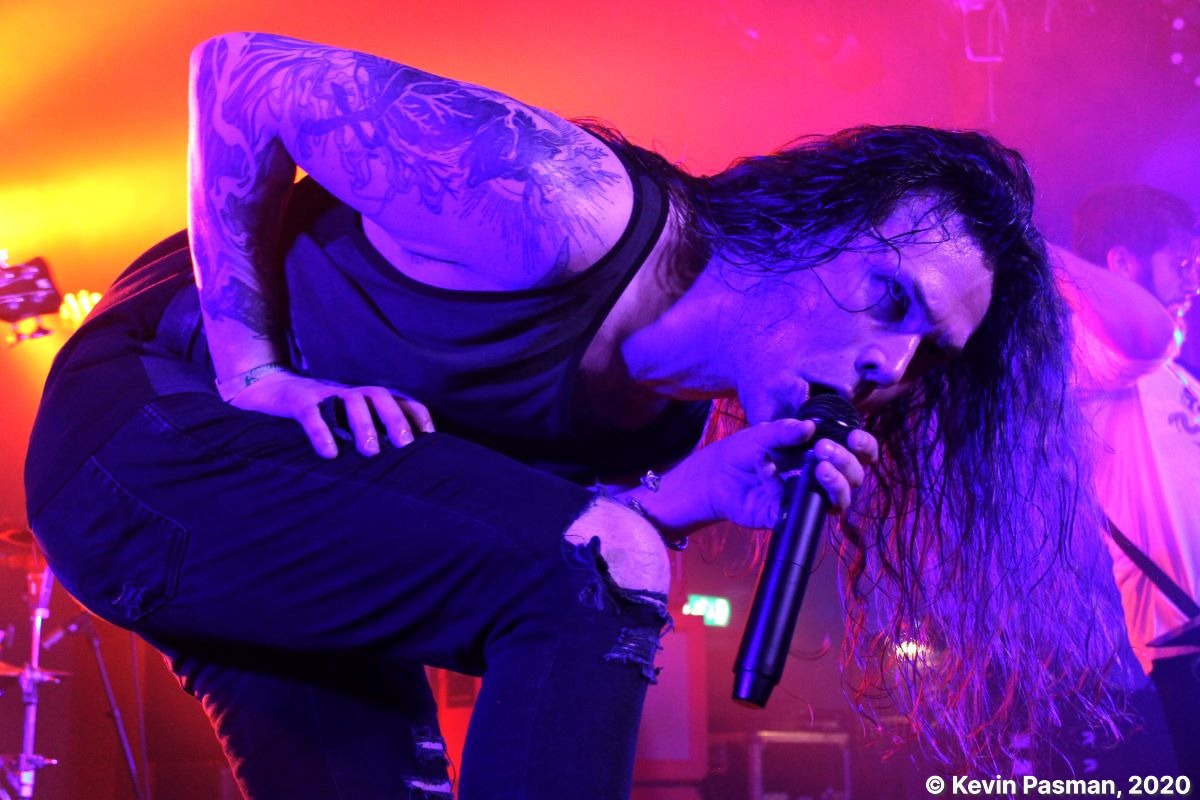
No, this is not some kind of BuzzFeed-style quiz, but a snappy title was needed in order to dig into a subject that raised some eyebrows among my readers. The main culprit was my review of ‘Phantoma’ by Unleash the Archers, in which I referred to Grant Truesdell’s vocals as “cappuccino machine growls”. Sometimes you need to confuse a few people to realize the things that make perfect sense to you don’t necessarily make sense to others. Since this site mainly covers releases with clean(-ish) singing – which I greatly prefer – an explanation of my growl nomenclature may be in order.
First off, I can’t in good faith claim divising this naming system by myself. Many of this terms were coined with my Chaos Asylum bandmates Dennis Onsia and Rick Jongman, both of whom play in the excellent avant-garde black metal band Dystopia these days. It was a way for us to communicate what type of non-clean vocals we had in mind for certain passages. After all, there are only so many ways one can say “deep growl” or “high screech” before descriptions become unclear. The descriptions we used turned out to be quite helpful for my music reviews as well.
So let’s look at some types of growls that may end up in Album of the Week reviews. Starting out with the one that raised so many questions recently.
The Cappuccino Machine
The Cappuccino Machine is a type of growl that appears fairly often on the type of black metal recordings that I don’t like. It’s a very throaty sound without much body to it, and it is very much shaped by pushing phlegm and air through the back of your throat, which without any lyrics does actually sound like someone is trying to do their best impression of a cappuccino machine. It is often paired with copious amounts of reverb to give it an evil, cavernous atmosphere it would not have on its own.
This is far from my favorite type of growl, and I think Grant Truesdell mainly makes it work because a) the way layers them with lower gutturals masks a lot of this growl’s flaws and b) he is in a band with a vastly superior clean singer, so he doesn’t have to carry entire songs vocally. The fantastic songwriting on the last three Unleash the Archers albums helps as well. Grutle Kjellson from Enslaved is the only other example I can think of in a band I enjoy, and it took me ages to get used to his gutturals.
The Concrete Grinder
From one of my least favorite growling styles to my favorite. The Concrete Grinder is a loud, full-chested, blunt-sounding growl that often – though not always – has more of the vocalist’s natural voice seeping through than the common growl. Frequency-wise, it is on the lower end of the mid-spectrum. It’s almost like the tone is shaped by the mid-frequencies, but the body is created by the lower ones. Personally, I have found The Concrete Grinder working best with a slacker feel in the lower jaw than with most other vocal styles, but your mileage may vary.
My immediate reference for The Concrete Grinder is the growl that Testament’s Chuck Billy has employed since the late nineties. Being punched in the face by this powerful growl on ‘Fall of Sipledome’ and ‘Legions of the Dead’ on Testament’s 1999 ‘The Gathering’ album made me realize that even as a clean-vocal fundamentalist, I can appreciate some growls. Vader frontman Piotr Wiwczarek and Opeth’s Mikael Åkerfeldt are other prominent examples. I tend to really like how this type of growl lies in the mix, as it is powerful without completely overpowering everything else.
The Zetro
Named after former Exodus singer Steve ‘Zetro’ Souza, The Zetro is the only non-clean vocal I unequivocally enjoyed doing in my old band. Possibly because it’s the only one I could naturally belt out without lacerating my throat. It’s a high-pitched shriek with more body to it than The Cappucino Machine and some of the more screechy black metal vocals. It works best in short, punchy bursts, like the last few words of a verse or chorus. But if you can muster up the stamina, it could work for a complete section of a song.
Perhaps I’m being too critical, but Souza is the only vocalist I know that has fully mastered The Zetro. There is one thrash metal vocalist who comes quite close, and that is Sacrifice’s Rob Urbinati. Sadus frontman Darren Travis has a similar vocal style, but it was too shrieky on the first Sadus album to be a full-on Zetro, and too much of his normal voice came through for it on their later work. When applied correctly, The Zetro can truly sound like the singer in question is spitting venom into a listener’s ear.
The Bark
The Bark has been a prominent vocal style since the early days of thrash metal, and among bands with a strong hardcore influence in particular. It isn’t uncommon for the first generation of death metal bands to have a vocal approach that finds the middle ground between The Bark and a more traditional, deeper growl. The Bark is a mid-ranged type of grunt, often performed staccato. It generally doesn’t quite sound as powerful as most other growls, but it does tend to be more intelligible, which of course is a massive benefit if your lyrics are worthy of being understood.
Another advantage of The Bark is that it typically allows more of the vocalist’s character to come to the surface. From the slightly lazy tone of Max Cavalera on ‘Beneath the Remains’ and ‘Arise’ to Leif Jensen’s blunt and fairly high-pitched aggression in Dew-Scented, Barkers tend to be easily recognizable. One of my favorite Barkers isn’t actually primarily known as a vocalist, but Cannibal Corpse guitarist Rob Barrett sounds absolutely vicious on Solstice’s self-titled debut album.
The Grain
Translating this one’s name isn’t doing it any favors, as its Dutch name – De Korrel – sounds better, but it does paint a picture. The Grain is loud, grainy, and not very dynamic, almost like a wall of static noise. I generally find The Grain quite exhausting to listen to, which isn’t helped by the fact that, like The Cappuccino Machine, it is often very up-front in the mix. This might be the result of The Grain covering quite a lot of frequencies on its own. Technique-wise, it feels similar to The Concrete Grinder, but a lot more throaty, adding a significant amount of high frequencies.
Although I don’t have many Grains in my collection, it has popped up on a sizeable number of hardcore, metalcore, post-hardcore, and screamo releases over the past quarter century. The only band that prominently features The Grain that I listen to is Between the Buried and Me, and even their albums I mostly cannot listen to front-to-back because of The Grain’s prominence, unless Tommy Giles Rogers uses it sparingly. Or not at all, in case of ‘Coma Ecliptic’.
The Van Drunen
Every old school death metal fan will immediately know The Van Drunen upon reading its name. Asphyx and original Pestilence frontman Martin van Drunen has a growl that is truly one-of-a-kind, though I suppose Obituary’s John Tardy has a vaguely similar tone. The Van Drunen is a paradox. It’s all high-frequencies, though there is some mid-frequency projection in it. For the uninitiated, The Van Drunen may sound similar to someone trying to speak while crying uncontrollably, except with a surprising amount of control on the vocalist’s end. A growl that truly stands out.
Dennis, Rick, and I just really liked the character in Van Drunen’s voice, so we often tried to emulate it and put it in a song somewhere as a small tribute, if we could fit it in. I’m not sure if this is still the case in Dystopia, but I do distinctly remember hearing it featured prominently on one of the songs on their debut album ‘Decay‘. Not necessarily the most versatile growl around, but somehow, it always sounds emotional, which makes it work really well for intense passages.
The Burp
Exactly what it says on the tin. A deep, powerless, barely intelligible growl – and sometimes not even that. Full disclosure: I can’t stand The Burp as the main lead vocal style. In my Chaos Asylum days, Dennis Onsia was really good at layering The Burp underneath a Bark or a Zetro, and that does work wonders if your lead vocalist – me, in this case – doesn’t have a very good lower-range growl in his arsenal. To me personally, it’s more of a layering tool than a vocal style that should carry an entire album.
However, that does not mean that bands don’t try. In fact, the example that comes to mind immediately is the Finnish death metal band Demilich. Their sole full-length ‘Nespithe’ is considered a classic in progressive and avant-garde death metal circles. And for good reason: its unpredictable compositions and Gorguts-esque riff work – before Gorguts themselves were doing it – are spectacular. I just can’t get over Antti Boman’s barely audible croak. The upside to it is that it’s fairly easy to zone out this vocal style.
So there you go: these growls are common enough on releases that might be reviewed here to warrant some explanation. This list isn’t exhaustive; there are certainly more types of growls, but they are either rare in styles covered here, or they post-date this growl naming system. Those may be added if they become relevant.
 Kevy Metal
Leave a comment