
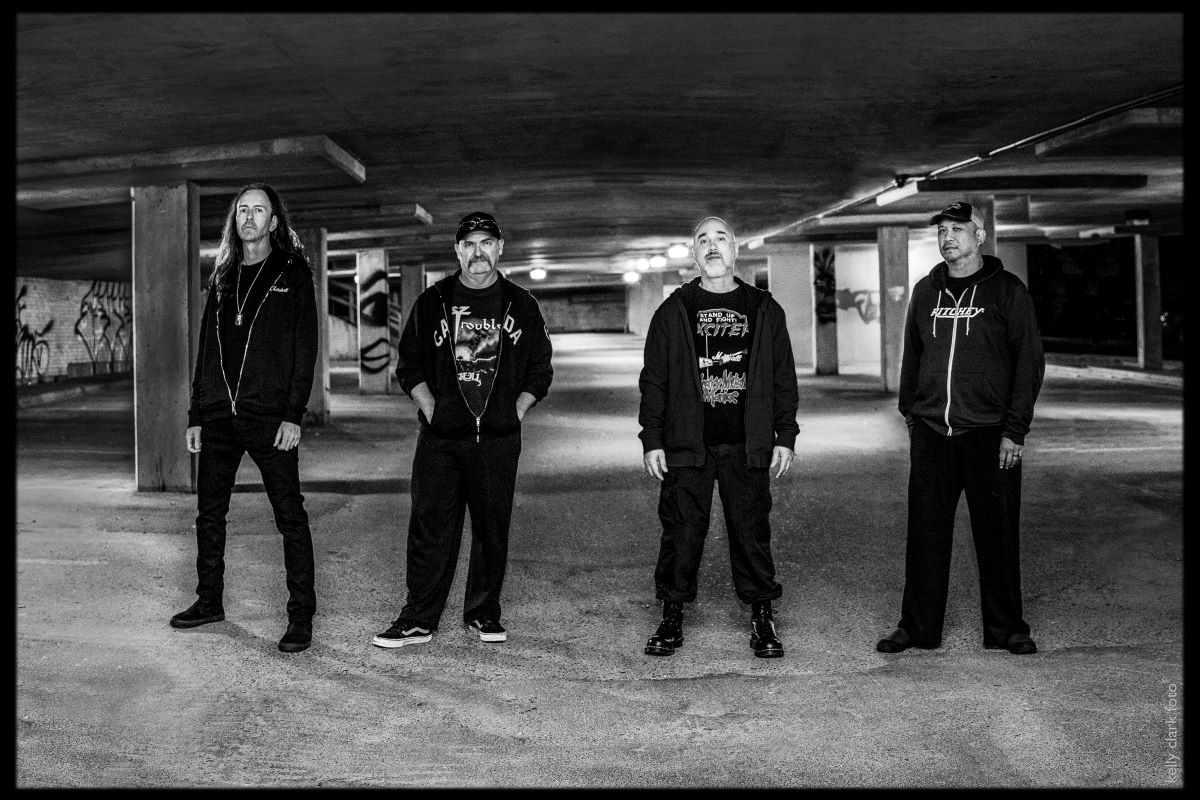
‘Volume Six’ proves that even after a sixteen-year break from releasing any albums, Canadian thrashers Sacrifice have lost nothing of their vicious energy or their depth in the songwriting department. Or any of the members from their classic line-up. Singer and guitarist Rob Urbinati shares what has been going on in the Sacrifice camp over the last decade and a half.
“About five or six years ago, someone mentioned to me: I think you guys are the last classic thrash band with the full line-up intact”, Urbinati recalls. “And I thought: it can’t be. Then I started going over them in my head, and finally came to the conclusion: yeah, I think we are. If someone knows another band, please make it known, because I can’t think of any.
I think part of the reason is that this isn’t our main source of income. This isn’t what we do for a living. We don’t have the pressure of whether you’re going to do a tour or not for worry about whether the bills are getting paid. We’ve all known each other since we were kids. And we know each other well. We get into a rehearsal room, and it’s just like we still feel like we’re twenty years old. We’ve been together so long that we don’t really have any petty things that we argue about; we’re pretty much on the same page.
Obviously, we’re not doing this for the money. This is something we love to do. Playing live is great, and we love being in the studio. We don’t record that often, so when we have songs written, the day before we get into the recording studio, it’s like little kids at Christmas time. We can’t wait to get in. This is what we want to do.”
In the Interim
While Sacrifice has been steadily playing live since releasing 2009’s ‘The Ones I Condemn’, writing ‘Volume Six’ began a little more recently. “I’m kind of fuzzy on the year, but it was sometime around 2017 that I had written a couple of songs”, Urbinati says. “I’m always writing songs and passing them on to the guys, but that was when I wrote two songs, passed it by everybody, and everybody seemed to like it. That’s what kind of started the whole thing.
With a lot of bands from our era, when you’re playing live, most of your fans are going to want to hear your early material. It’s almost not even necessary for those bands to release an album. We’re in a different situation than most bands, as Sacrifice isn’t our main source of income, it’s kind of like part-time. We don’t really have the need to tour every year. But we did have new music that we wanted people to hear.”
Surprisingly, the band’s well-received 2021 single ‘World War V’ is not on the album. “I wasn’t really planning on it making the album”, Urbinati explains. “That was done during the pandemic. We were finding it really difficult to rehearse, but I had this song, and we decided to just experiment and see how it goes. So we all remotely did our parts, and the band said: why don’t we release this as a single or something? It came out pretty good.
We also knew at the time that it was going to be a while before we were going to be able to get into a studio. Our rehearsal time was so sporadic with things shutting down during the pandemic, so it was getting really difficult for us to get the songs tight. So it was a good thing to have that in the interim.”
A Level of Athleticism
Getting the songs tight is clearly an important matter to Sacrifice. Recent live videos show the band’s playing to be very on point. Even on the live DVD ‘Re-Animated’, which features their 2006 reunion performance, it sounds like the band never stopped playing together. “We were really nervous before that show”, Urbinati admits. “We hadn’t played a live show in sixteen or seventeen years. We broke up, and that was it.
For that reunion show, it took us a long time to get our chops back, to be honest. Especially for Gus (Pynn, drummer) and myself. It took a lot of practicing at home to be able to play these songs well again. I think if we were to watch that video again today, we’d say we’re playing better today. That show, for us, was to check if we can still do this. After the show, we said: yeah, we can do it still, let’s do another album.
When we got back together in 2006, we were maybe around forty years old. If we weren’t consistently playing since then, I don’t know if we would have been able to do it anymore. It’s like people say: an athlete has to train, right? There’s some level of athleticism to it. Especially for a drummer. Even as a guitar player, with that right-hand picking.
When I was a kid, I’d go see Judas Priest live, and I’d think: these guys are old. At the time, they were probably around thirty years old or so. I find it amazing that Rob Halford is in his seventies, and he’s still bringing it live. It gives a guy like me hope that maybe I can too, haha!
Sometimes it’s also mind over matter. There are times, especially live, when Gus will amp up the drums even faster. Then after the show, we’ll say: we could barely play it. And he’ll say: well, you did play it! Haha! If we get to the point where we feel like we can’t do it like we used to, that’ll be it. This isn’t the type of music that you can sort of play. It’s black and white: you can either play it, or you don’t.”
Air-Guitarable
Sacrifice’s tightness would allow for both Urbinati and fellow guitarist Joe Rico to record rhythm guitars for the band. This is not what happened on ‘Volume Six’, though. “On this one, I did do all the rhythms”, Urbinati points out. “It was logistically difficult for us to have us both record rhythms this time. But Joe is a much more accomplished guitar player than myself. For the guitar solos, I mainly just say: Joe, go for it, haha!
On the new album, I think I maybe play three leads on the whole album. As a listener, I just love Joe’s lead playing. He can construct very air-guitarable leads. He can shred, but he knows when to do it, and he’s very tasteful. I just love how memorable his leads are. For me, as a guitar player, why do I want to play when this guy is in our band?
I feel that a lot of recordings these days are very sterile-sounding. There’s a lot of editing in today’s recordings that we try to avoid. We don’t even play to a click track, because when you do, that temptation to over-edit your material is always there. And I just feel sometimes bands are taking the soul out of their music by quantizing everything and making everything perfect.
Yeah, I sound like an old guy, but too much music these days has no soul. It’s just way too mechanical. And there are bands where that works. Like Fear Factory: I want Fear Factory to sound mechanical. That’s their thing. But I think a lot of things changed when they released ‘Demanufacture’. Everybody was going for the clicky drums and that extremely edited sound. It just never left. I sometimes just kind of wish more bands would go into the studio and just go for it, just play.”
Getting the vocals Down
One thing that stands out about ‘Volume Six’, as well as ‘The Ones I Condemn’ before it, is how well Urbinati’s fairly high-pitched shouts have stood the test of time. “To tell you the truth, when I go to rehearsal, I’m practicing guitar”, he emphasizes. “A lot of times, the mic’s not even on in the rehearsal room. Especially when we’re ready to go into the studio. Getting closer to getting into the studio, I’ll start getting the vocals down a bit more.
If we have a show coming up, I’ll go pretty hard with the vocals. But it is something I need to get back into. You have to achieve some sort of stamina before you’re going to play live. I’m by no means Geoff Tate or anything, but it still requires a level of technique you have to practice.”
Urbinati fully admits to sometimes having issues making the vocals fit the music: “When I’m writing, quite often, haha! What I usually do: before I even start writing the lyrics, I try to get where the phrasing is going to go. And then I’ll start working the lyrics into that. There’s a lot of times where it takes a bit of practice to pull off what you’re writing, haha!
There are Sacrifice riffs that sound relatively simple, but the stamina it takes to play it takes a lot of practice. And then there are the riffs that are kind of deceptive when you listen to them, that aren’t that hard to play, even though they have a million notes. It’s the right-hand stamina stuff that is the most difficult Sacrifice stuff to play.”
The Rules of Thrash Metal
On the more intense, high-speed side of the thrash metal spectrum, Sacrifice is one of the bands with the most sophisticated songwriting chops. “Our influences have pretty much remained consistent from when we started”, Urbinati says. “We grew up before metal turned extreme. We were into hard rock. Van Halen, Sabbath, Ozzy: that’s what we listened to when we grew up. At some point, Accept came out, and Venom, and metal started getting heavier. We went that route, but we never abandoned those old influences we had.
Even Rush: a trained ear could tell that there’s a Rush influence on certain parts of our songs. That part of us never left. And I feel sometimes the rules of thrash metal have become this very small box. Which is fine if that’s what you want to do, but I don’t feel like we’re confined by that box. Our criteria for if we’re going to continue with any idea is: do we like it? There are times when I’m writing something when I think: is this a Sacrifice song or not? But then I pass it by the guys in the band, and they like it, so we’ll go for it.
At some point, we really started concentrating on songwriting. When I say that, I don’t know if people really understand what I’m talking about. It’s more than having a really great riff, and then following it up with another great riff, and then another great riff. There have to be things that get your attention more than the riff. And we started learning this: there have to be twists and turns, and not every riff has to have a million notes. Just learning these things really helped us along the way.
When thrash metal started, there were bands like Agent Steel or Znöwhite. The sound was pretty diverse. That diversity in sound has gotten very compressed into one little cube. But having said all that, at the core of it, we’re very obviously an old school thrash metal band. I don’t think anybody’s going to dispute that.”
Sporadically Apocalyptic
Lyrically, ‘Volume Six’ appears to be cut from the same dystopian horror cloth as much of Sacrifice’s earlier material. “Our lyrical content has been sporadically apocalyptic, I guess”, Urbinati describes it. “When I sit to write a song, it’s always music first, and I like to kind of digest what feeling I’m getting from the music. That usually points me in a certain direction. The music is pretty apocalyptic-sounding on its own, so it lends itself well to these themes.
And especially these days, it feels like the world’s taking kind of a dark turn. I think that feeling you get when you watch the news; it kind of puts itself into the lyrics. Look at what’s happened to people through social media. It’s become a gigantic propaganda machine that has the power to change people’s views on certain things. And when you’re reading posts, you’re not even sure if it’s from a human being. So the world is becoming that dystopian place, I’m afraid.
There are other themes. We have the ancient civilization theme that we’ve always had, with songs like ‘Lost Through Time’ or ‘Salvation’. We have a song on the new album called ‘Underneath Millennia’ that kind of has that same sort of vibe. Our lyrical themes from ‘Forward to Termination’ on have been sort of consistent. They talk about current world events, and past world events.”
The Simplicity of It
Urbinati has been seen playing various guitars through the years. “Right now, I find that I keep going back to an EVH Wolfgang Special that I play a lot”, he says. “I remember picking up this guitar and thinking: oh my god, Eddie really knew how to spec out a guitar neck. It’s just a very comfortable guitar to play. I love it. But I can play any guitar; as long as it feels good in my hands, it’s all good.”
That includes the Schecter V that he is seen with in many recent live recordings. “I do play that a lot”, he nods. “I find that Schecter makes very reliable guitars. When you buy a new Schecter, it’s QC’ed very well. They have their guitars set up perfectly, pretty much. They’re very well-built for taking them on the road, even if you’re going to fly with them.
My main amp right now is a Mesa Boogie .50 Caliber+. Usually, when we play festivals and we’re not bringing our own equipment, I like playing 5150’s a lot. Dual Rectifiers I can play, but I don’t really like the sound as much as I like that .50 Caliber+ that I have. There’s a lot of low-end to those Rectifiers. But if you have your pedals in front of the amp, I think you could probably amp up the attack a bit.
When we first got back together, like on that ‘Re-Animated’ DVD, I was using no pedals. I would take a plug, put it into my guitar, and go straight to my amp. And I played like that for a long time. I like the simplicity of it. And then at some point, I started adding a couple of pedals in. But I still keep it pretty basic.”
Eight-Hour Drives
Despite the fact that Sacrifice comes from the populous Toronto area, touring Canada has come with its own set of challenges for Sacrifice through the years. “We have toured Canada a few times”, Urbinati emphasizes. “And it’s a difficult country to tour, definitely. Second largest landmass country in the world, and I think our population is around 40 million now. Pretty spread out.
Where you can tour Europe and get to the next city in three a hours in a lot of cases, it’s at least an eight-hour drive between every two shows here in Canada, if not more. So yeah, it’s very challenging. We’ve also toured Canada in the winter, which is extremely challenging. But, you know, it was very rewarding for us.
We got to play a lot of places in Canada that most bands don’t really go to. Especially back then. Thrash metal bands would not go to the east coast, or even a lot of towns on the west coast. We got to play everywhere in between. Back then, it was very rare that bands like us, the more extreme bands, would come into town like we did. It would be us and Razor, and that would be it. And maybe Voivod.”
Extensive touring outside of Canada also will be difficult at the moment. “Unfortunately, that’s not going to happen”, Urbinati says. “A lot of times it’s hard for us to play Europe, just because we aren’t that touring band. It’s difficult to make it work financially. So we’re hoping that we can find a couple of festivals that will take us, just so we can get over there to play. Because we love to play in Europe. Europe has extremely well-run festivals. Bands are treated very well there.”

 Kevy Metal
Leave a comment