
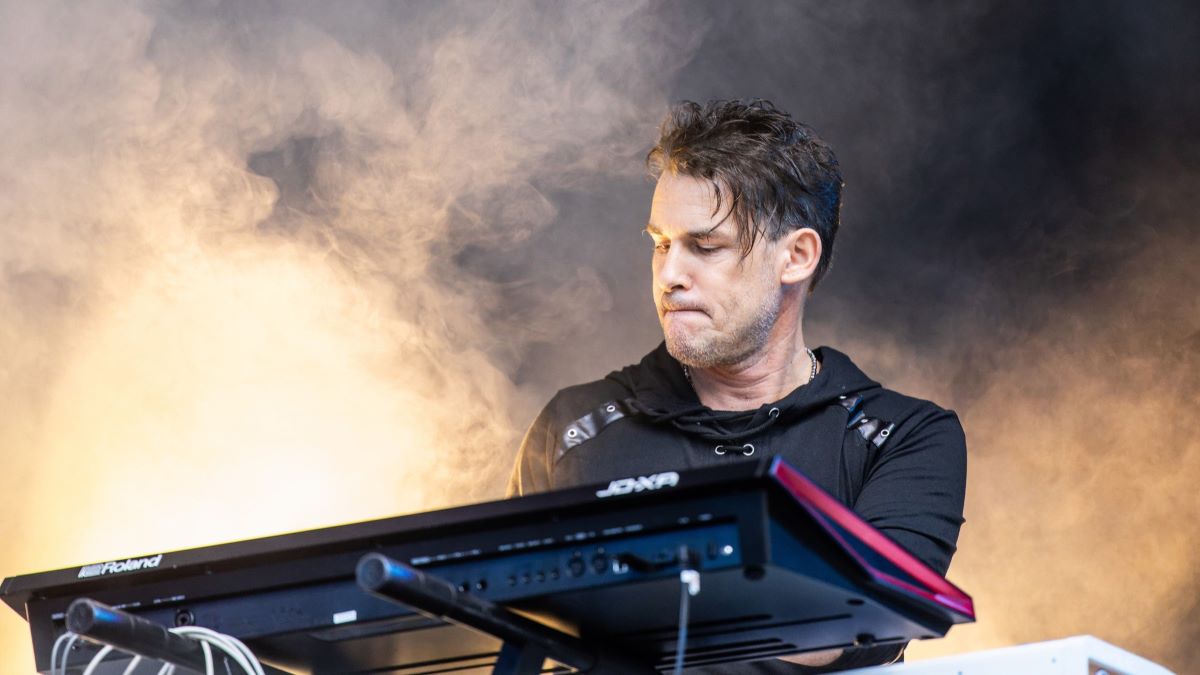
In a genre where orchestral layers and blaring solos are the norm when it comes to keyboards, the approach of Italian musician Oleg Smirnoff is a breath of fresh air. He is melodically as strong as many of his colleague progressive power metal keyboard players, but his use of electronics, his textural layering and his sonic choices put him in a class of his own. Smirnoff gives us a look into his influences and his vision on the use of keyboards in metal.
“The guys in Labÿrinth are often very surprised, because I seem to be the only keyboard player they know who stays silent for long parts of the songs”, he smiles, explaining his role on the new Labÿrinth album ‘In the Vanishing Echoes of Goodbye’. “But in my point of view, that’s the way keyboards have to be. Keyboards have to add dynamics to the songs. So there will be parts of the songs – for instance, the verses – where I stay silent. And then I enter, and that’s what changes the dynamics. That is what I want.
The fact that the songs are very dense is a problem for the keyboards, of course, because in the final results, I always hear my beautiful sounds mangled and sounding grainy, crushed by how it has been equalized, because you have to make room for beefy guitars, and loud drums. That’s a thing I would like to change, but it’s not possible. I try to do it with my other bands, but the result is more or less the same. Because Eldritch has big guitars as well.”
Not Playing Anything
Smirnoff was introduced to the metal world in through his work with horror rockers Death SS and Eldritch, whose albums ‘Headquake’ (1997) and ‘El Niño’ (1998) are considered minor classics in European progressive metal. He first worked with Labÿrinth guitarist Olaf Thörsen in his other band Vision Divine, but fairly abruptly quit all bands he played with in 2005.
“When I got back into Labÿrinth, I had spent twelve years not playing anything”, he admits. “Then Olaf Thörsen called me: we want to record a new album with Labÿrinth, do you want to join? My family situation was a little bit more steady at the time, so I said yes. The first album we recorded, ‘Architecture of a God’ (2017) was sort of continuing what we were doing with Vision Divine, because it was a little more progressive.
But Labÿrinth was one of the first bands of the new wave of European power metal, so they weren’t very happy to insert too much prog or strange synths into their sound. So the next album, ‘Welcome to the Absurd Circus’, was a big return to power metal. In all honesty, I was slightly disappointed with that, because the space I had was getting tighter.”
Stitching Parts Together
Regardless, Smirnoff is content with his position within Labÿrinth. “More than writing the songs, I am given some space to modify the structures of the songs Andrea (Cantarelli, guitarist) and Olaf have already written and recorded”, he explains. “For instance, the first song on ‘Architecture of a God’, ‘Bullets’, has changed a lot since I intervened. And I’m quite proud of it. The primary version was a more ordinary and less dramatic power metal song. Then it has changed into a sort of strange, multi-form thing of the kind I like.
You have a keyboard intro that sounds like Giuffria – Gregg Giuffria was my first influence in playing keyboards – and then you have a long section of twin solo parts. Those are all things that came from my work, so I was quite happy. Another song I like very much is the title track. ‘Architecture of a God’ is one of my favorite songs of all time, out of the ones I have played on. These days, we are more power metal. But the band is very good. Great musicians, and great guys. I’m very happy with them.
Whenever we have parts that don’t go together very well, the first thing the guys do is say: Oleg, find something to stitch together those parts! One of my favorite songs on the new album is the last song, ‘Inhuman Race’. It was another one of those strange things, because it was made up of very different parts. At the very start, you have two and a half minutes of quite strange instrumental music. So they told me: find something to make it interesting, otherwise we have to cut that part. I’m quite proud of how the song came out.”
Methods of Making Songs
A few years after joining Labÿrinth in 2016, Smirnoff also re-joined Eldritch, where he is an integral part of the songwriting team. “For the last Eldritch album (‘Innervoid’, 2023), I didn’t have enough time to write more, because I was very busy with work, where there was a lot of stuff going on”, he clarifies. “So my main contribution there were the two songs I wrote from tip to toe: lyrics, vocal melodies and all arrangements (‘To the End’ and ‘From the Scars’).
In Eldritch, we rehearse together a lot. So it’s a different thing, because we prepare the songs together in the rehearsal room. With Labÿrinth, all the guys are from different cities in different parts of Italy, so it’s quite difficult to put all six members in a room together. So the composition process is mainly something everyone does at home, and then we find ourselves in the rehearsal room shortly before we go in to finish the album.
Eldritch is an old-style band that does a lot of rehearsals. I like that old method of making songs very much. The songs end up smoother and more organic as a result. The result is simply different. In my point of view, you have the chance to do better when you do things together in the rehearsal room.”
Expected Sounds
When it comes to the equipment Smirnoff uses, the differences between Eldritch and Labÿrinth aren’t all that big. “I use a piano and my analog synths”, he summarizes. “A lot of the sounds are made with plug-ins that reproduce the sounds of my favorite keyboards, which are the Oberheim OB-X, the Roland Jupiter-8, and the Roland Juno-106. I have the original Juno-106 at home, but unfortunately, I don’t have an OB-X. And then I add some virtual analog synth parts.
Simply looking at equipment, there is no difference between Eldritch and Labÿrinth. What is different, however, is the choice of sounds. When you play power metal, you are expected to play orchestral sounds and harpsichord, and stuff like that. With Labÿrinth, I do use the harpsichord sounds, which is a thing I despise, but it fits their sound well. You’ll never hear a harpsichord or an orchestra with Eldritch, though.
The truth is that I’m active in a genre of music which has had the same sounds for the last 35 years or so. In progressive power metal, the sound changes very, very little. I have tried to put some new things into some songs, but the audience doesn’t want to hear too many new things. If we’re being completely honest, many people who listen to heavy metal could likely do without the keyboards altogether.”
A Forest of Keyboards
When asked how many of his keyboards Smirnoff brings with him to live shows, his answer is simple. “As many as I can”, he smiles. “Because I’m rather clumsy when it comes to changing sounds, pressing pedals, and things like that. I’m not very precise. Also, my heroes are all keyboard players who played in a forest of keyboards. Four keyboards on the left, five keyboards on the right, and four or five keyboards behind them. So my idea of keyboard playing is that.
I don’t like playing with only one keyboard, and I will never do it. When I play with Eldritch, I have four keyboards. A large share of my parts is played with the Roland JD-XA that handles both the digital and analog sounds well. And then I always have at least another keyboard with 88 keys, because I need it for playing the piano parts. The other two keyboards are multi-purpose synths with sounds varying from song to song.
It’s not always possible to bring four keyboards, so sometimes, there are three, or even less. Recently, I played in Germany with Labÿrinth, and I had to make do with two keyboards I found there. Theoretically, I could do a full gig using just one keyboard as a controller and an iPhone as a sound generator, but I never even tried. I don’t like the aesthetic of being on stage with only one keyboard and a PC.
Also, every son we play has at least three or four different sounds, so I would need to move something in order to change the sounds if I had only one or two keyboards. When you play live, everything is very loud, and you’re in a dark place, so once you’re deafened or dazzled, it can be very difficult to make those changes the way you want to. That’s why I choose to divide my sounds over various keyboards.
I have maybe seventeen or eighteen keyboards at home, and I bought a large car just to stuff them all into the car, and get them out to gigs. People sometimes hate me for the time I spend assembling my rig, but I don’t care, haha!”
An Instrument That Has to Be Practiced
While Smirnoff prefers to record the piano parts on the albums he plays on acoustically, most of them are not. “Not on this one, because we didn’t have the budget”, he admits. “But mostly, I didn’t have the time to go to the studio, where there is a Bösendorfer. On the last Eldritch album, ‘Eos’ (2021), I did play the acoustic piano.
Unfortunately, I don’t have the time to practice the piano as much as I should. And I should do that more often, because a piano is an instrument that has to be practiced. There is no way you can record piano parts properly without practicing a lot. I did do that when I was young, but I can’t anymore. I have a family, I have two children, I have a job different from music, so my life is quite busy.
One of my goals for the future is finding the time and the space to get back to the piano. Because the piano is special. And I’m absolutely not satisfied with any of the piano parts I have recorded in my career. Especially the first few Eldritch albums have horrible piano sounds. It’s not easy.
Other bands seem to have similar issues. For instance: a band I appreciate a lot is Symphony X. Their compositions and their sound are outstanding, but I don’t like the sound of certain piano parts. But that’s a minor detail: they remain a great band.”
A Melodic Tradition
Smirnoff started playing electronic keyboards when he was a teenager. “That’s when I started listening to music carefully”, he says. “The masters of the game, at least here in Italy, were Duran Duran, Howard Jones, A-ha, and stuff like that. I was playing those things on the piano, and the sound it made in my mind was the Roland stuff that those artists were playing. Sometimes that influence stands out when I write songs. It’s a thing I can’t fight.
Then in the nineties, I started playing and producing music, and I was very fond of Nine Inch Nails. Nine Inch Nails were one of my biggest influences for the use of electronics. Also, Marilyn Manson, who I don’t like very much for all the things around his music, but the music is interesting. In my point of view, some of the things Marilyn Manson made are this century’s version of the Sex Pistols.
Marilyn Manson’s 2003 album ‘The Golden Age of Grotesque’ sounds absolutely great. And all electronic; you’ll hardly find anything acoustic in its sound. It’s heavy, it’s raw, it’s abrasive… I like it very much. I tried to have a similar sound, but it was difficult. That music is totally non-melodic, but in Italy, we have a melodic tradition that you cannot break through. Every band you join will ask you to play some melodic stuff.
In my opinion, the most interesting things that I have heard in music in the last twenty years are in electronic music. So I always try to keep one ear on the electronic music scene, because I hear great things coming out of it.”
An Alternative to Playing Harpsichord
“When we recorded ‘Architecture of a God’, the guys in Labÿrinth proposed to do a cover of an absolute anti-metal song, which is ‘Children’ by Robert Miles. You have to understand: that was the kind of music that everyone who was into metal was hating at the time. Putting a cover of this song on a metal album was a big challenge. Plus, the arrangement had to be made very quickly in the last two days of the recording, but I’m pretty satisfied with the result.
I put my best effort into making it sound interesting. I did not want to keep the dreamy piano parts of the original version, because it sounds horribly mellow. So I reversed the sounds of the parts. The main melodies are recorded with a strange Yamaha DX7 sound, and the piano is in little phrases in the background. And it seems to work. At least it’s funny. It was good to have something so electronic on that recording. Just as an alternative to playing harpsichord.
The concept behind electronic music is the opposite of heavy metal. In heavy metal, you have to play very dense parts, very tight, very fast. For me as a keyboard player, electronic music works better, because there is more space to hear the sound. Sometimes, in electronic music, you have these big, empty parts, where you hear a single sound going for ten seconds with a lot of effects. If the sound is beautiful, even one note by itself will work.
I used to go to discos just to take a listen to this kind of music, because I live in a part of Italy that’s very famous for its nightlife. When you hear such electronic music over big PA’s or big amps, the sound is not that far removed from heavy metal, because the punch is the same. I heard a lot of interesting things, and I tried to incorporate the good parts of them in my own sound, leaving aside the tacky parts.”
The Sound of Heaven
“My musical tastes are very broad. I am very much into classic progressive rock and new progressive stuff. My comfort zone is in the new prog wave of the eighties. I like Marillion, IQ, and Pendragon very much. That was what moved me towards a certain kind of music. I like classical music as well, because I used to be a piano player as a child. But I like lots of different things. I get bored of certain types of music very quickly.
As much as I like electronics, I like the traditional sound of a live band. The sound of a band playing lie in an open-space arena on a summer night is the sound of heaven to my ears. One of my favorite albums is the live album ‘The Spirit’ from Magnum, from 1991, because it fully captures that sound, that atmosphere.
The keyboard player is Mark Stanway, who is one of my top three keyboard players. He is a great of the instrument, because he makes everything sound beautiful, even if he plays old and raw-sounding keyboards. He has the Elka Synthex, and the OSCar. If you put headphones in one of those synths, you will hear a sound that is rather gaunt and rough. Very different from the sound of today’s machines. But in the hands of Mark Stanway, they sound beautiful.”
An Act of Rebellion
“It may sound strange, but church music has been another big influence for me. You have to understand: the church has a big influence on almost everything in Italy. My theory is that a lot of Italian people have become metalheads as a consequence of hearing a certain kind of church music.
During my childhood, mainstream music was too light, and silly, and happy. Only in church did I find music that could be emotional, deep in meaning, and even epic. I remember hearing a loud, roaring church organ reverberating in dark archways, and it fascinated me. And some of the church chants I heard in my youth really had the epic vibe that I later found in the works of bands like Manowar, Virgin Steele and Queensrÿche.
When Iron Maiden was making ‘Powerslave’, when Judas Priest was making ‘Defenders of the Faith’, when U2 was making ‘The Unforgettable Fire’, and The Police were making ‘Synchronicity’, we had stuff like Pupo, Ricchi e Poveri, and Al Bano and Romina Power on Italian radio and tv. Terrible silly, happy music.
As an Italian born in the seventies, I think we can be proud that we have bands these days that can keep up when compared to German or American bands. In the eighties, that was absolutely unthinkable. I think that the great success of metal music in Italy – especially epic heavy metal and thrash metal –has come as an act of rebellion to the terrible music that was everywhere on Italian television in the early eighties.”
Not as Good as They Say
Having said that, Italy did have a vibrant progressive rock scene in the seventies. “Yes, I am a big collector of vinyl records, and I have almost every Italian prog release of the seventies”, Smirnoff nods. “Not everything, because many of those records are very expensive. And I have to say: not everything is good as they say.
We had great bands, like Banco del Mutuo Soccorso, and Premiata Forneria Marconi. But then we have some cult bands that recorded one or two albums that now cost 300 euros. And in my opinion, those albums are not worth that amount of money. They’re not even worth 30 euros.
For me as a keyboard player, Banco del Mutuo Soccorso are absolutely outstanding. I also like The Trip, which is not very prog, but it’s a type of dark rock music. And I like Area very much. Their keyboard player Patrizio Fariselli is great. But Area’s music is very difficult to the ear, because of the vocals and all the strange meters. Great stuff though.”

 Kevy Metal
Leave a comment