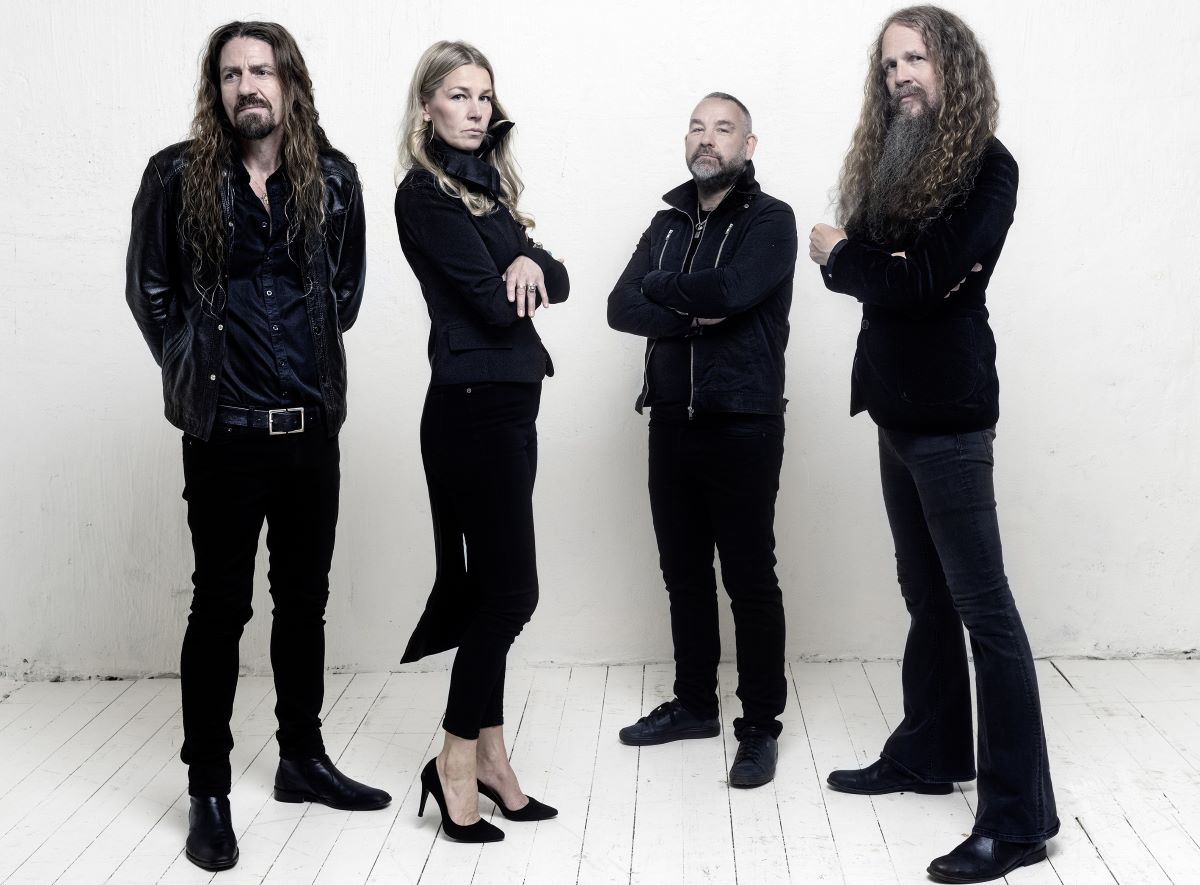
Over the last decade or so, Avatarium gradually changed from a Leif Edling-led doom metal project to a classy seventies-style, yet still quite doomy rock band under the direction of singer Jennie-Ann Smith and guitarist Marcus Jidell. Their new album ‘Between You, God, the Devil and the Dead’ might just be their most diverse work yet.
A remarkable thing about ‘Between You, God, the Devil and the Dead’ is the fact that it’s quite keyboard-heavy, despite it being the first Avatarium album without a keyboard player in the line-up. “It started with me and Jennie-Ann writing all the music”, Jidell explains. “We wrote a lot of stuff on piano, actually. So while we wrote everything, we kind of recorded the keyboards ourselves. Also, Rikard Nilsson, who plays on ‘The Fire I Long For’ and ‘Hurricanes on Halos’, plays on the album.”
And that piano isn’t just any piano. “We brought my old upright piano up from the west coast of Sweden to Stockholm”, says Smith. “I bought it together with my late father when I was nineteen, and we used it on the album, which is such a great thing. I think it’s interesting that this album is a bit more guitar riff-based, although it stems from the piano.”
“Some riffs were actually written on the piano”, Jidell nods. “Different guitars and different instruments awake different things while writing music. I think the piano was important. Now we have gotten a harmonium, and I’m already inspired by that. We’ll see how that inspires the next album, haha!”
“I grew up with one in my classroom”, Smith smiles. “Our old teacher played it every morning, until I was about seven or eight.”
A Drive to Evolve
Although Edling left the band in 2017, ‘Between You, God, the Devil and the Dead’ is the first Avatarium album that doesn’t feature any songwriting contributions of his. “Leif is working so much with Candlemass”, Jidell clarifies. “And I’m actually working with him, producing the music, and we can’t be everywhere at the same time. He wants to focus on that. That’s great for us, because it enables us to explore writing music together, and try to get better at that.”
“That freedom, of course, comes with a great responsibility”, Smith states. “I think we set the bar quite high with our debut album, so that comes with a drive to evolve from there, and hopefully make something that I personally like even more. At least for me.”
“Leif asked us to write songs for the ‘All I Want’ EP”, Jidell says. “I asked him: what kind of song do you think we need? He said: I don’t know, write something we haven’t got yet, otherwise I can just write it myself. He thought it would be good if we would write something that’s something really from the two of us, and hopefully we get better and better at that.”
“Of course, as a songwriting team, it takes time to find your identity”, Smith continues. “I know what I sound like, and Marcus knows what he sounds like as a guitarist. But to write together… We had a very privileged situation where we would be asked to do tours, and meanwhile, it enabled us to write and develop our songwriting skills.”
Working Through Egos
“We have a deal about the songs”, Jidell shares. “Both of us have to like it while we’re working on them. If one of us doesn’t like a song, we have to either work on a different song or try to find a different direction for the song. And it works. In the beginning, when we did ‘The Fire I Long For’, I think it was a bit more difficult for us.”
“Much more difficult”, Smith laughs.
“Both of us had to work through our egos”, Jidell admits. “Maybe me even more than Jennie-Ann. We are married, and when your wife tells you that she doesn’t like the riff you came up with, it can hurt, haha! But we learned to be honest, and not take it personally, and just aim for what’s best for the song. Even if I love the riff, but we can’t find the lyrics or melody for it, or vice versa. Everything has to fit. And we have to be willing to kill our darlings.”
“Most of the songs that eventually made their way onto the album have been altered many times”, Smith explains. “They have had many different shapes and forms. Rhythmically and harmonically, just changing things around. One song was actually intended for the previous album, but we couldn’t find a way to make it work on that one. We liked the chorus, however, so we kept it.
For me, it’s been a learning process. The songwriting that I have done previously has been in a singer/songwriter tradition. I like to sit with my guitar and experiment with different tunings, Joni Mitchell-ish, and telling a story that way. Marcus, on the other hand, comes from an electric guitar-based tradition. He might write a song around a riff, and that will be the core of the song.”
Fun to Be Loud
Smith’s background in more acoustic-based songwriting does not mean she never knew how to rock. “I have been singing since I was a child, and it actually started off with me singing in rock bands in cellars with bad monitors – or no monitors – where I couldn’t hear anything”, she says. “I grew up in that environment. It wasn’t a bad school for if you want to do this later on in life, haha!
Then, as a young adult, it became jazz and pop. While starting university, I sang by myself, and as a freelancer, singing with Swedish artists. I’ve also been on tour with Liza Minnelli. But I have this big voice. It’s fun to be loud, to be free, and use whatever you’ve got. That doesn’t mean I sing with full power all the time, but I can. And I remember it being quite painful being a back-up singer, or whatever I did when I was in my twenties, and having to adjust, back down, and suppress what you really sound like.
So when Avatarium came along, I was very ready to be myself, and sing the way I do now. And I was allowed to do that. When we did those first demos, Marcus and Leif weren’t even looking for a female singer. But I did those demos to the best of my ability, and we were so surprised that it sounded good.”
“When Jennie-Ann was recording ‘Moonhorse’, Leif and I were telling each other: wow, this is fantastic!”, Jidell nods. “It was a lucky accident.”
A Huge Range of Dynamics
The fact that Smith hasn’t got a typical doom metal voice allowed Avatarium to move away from a typical doom metal sound. “It opened doors for us”, Jidell agrees. “That’s why the second album is quite different. It was a much bigger part of the production on that album. We wanted to try out everything we could do. All of us. Leif was part of that as well.
You can’t plan this. This was just something good that happened. Since then, we’ve been trying to get better at what we do. It started dark, heavy, and poetic. And we try to keep that vibe. But from the start, we also wanted to bring in hope and light in the music as well. That’s also very important.”
“Through intuition, you feel if the ideas match the band”, Smith states. “The two of us have the wish that it would be something different. And this is what it becomes: having a huge range of dynamics.”
“A lot of the bands we like – Deep Purple, Black Sabbath, Zeppelin – always did a lot of different things”, Jidell adds. “That’s what music is about. That’s what makes music interesting. Classical music is like that as well. I like that in music.”
Electric Guitar at Its Finest
“When it comes to sounds, we also come from different musical backgrounds, and have different preferences”, says Smith. “Marcus is a guitar virtuoso, growing up in the Yngwie Malmsteen era. I don’t have any relation to that, other than being a Swede. And then you meet your future husband, and he just happens to be this brilliant musician. But those clean, thin sounds have always been a bit difficult for me. I guess it’s probably how you’re built, and how you perceive things, and what you prefer. He has electric guitar DNA.”
“Of course”, Jidell nods. “I love Ritchie Blackmore, Jimi Hendrix, all these guys. That’s where the electric guitar is at its finest. But I also love Neil Young and his nasty, fuzzy sound. I like a lot of different sounds and ways of playing the guitar. I’ve also been very interested in learning how to get great sounds. How do you get a good drum sound? Or a good acoustic guitar sound?
When I learned, I got that knowledge: okay, this is how I record an acoustic guitar and make it sound nice. Now how can we make it sound not so nice? Let’s experiment with that as well. Because I also love old blues players like Muddy waters, or old fifties rock ‘n’ roll stuff. I love electric guitars and acoustic guitars deeply in different ways.
I’m a big fan of old Marshall amps. I have a Super Bass from early 1973, and then I have a JCM800 from 1983. Those are my main amps, and I used them on this album. I also have an Olsson, from a great Swedish amp builder. They all sound fantastic.”
Just a Bunch of Pieces of Wood
“My old Les Paul is a Les Paul Studio from 1995 or 1996”, Jidell continues. “A very good year for the Les Paul Studio. I played that guitar every show for about ten years. It was the first Les Paul I could afford. But it’s been sitting for a while, because I was using other instruments. Then I switched the pick-ups on it to P-90’s, because I like Leslie West from Mountain. Then the neck broke quite shortly after that. But my guitar repairman here at GuitarLabs fixed it. After that, the sustain got so much better.”
“It blossomed”, Smith smiles.
“That’s the guitar I think I use most. But I also have my SG that I’ve been using a lot on all Avatarium albums. The main guitars are the Studio – which is quite a cheap guitar for a real Gibson, but it sounds amazing – and the SG. I blend that with Strats, Telecasters and other guitars.
We both like acoustic guitars. We mainly use some Gibsons that we love. And Hagstroms, especially live. I have a Hagstrom twelve-string that I also use quite a lot. Maybe not so much on this album, actually. My favorite is my SJ-200.”
A quick browse through Avatarium’s YouTube channel also reveals a small parlor guitar. “That’s my grandma’s old guitar”, Jidell smiles. “Also a fantastic guitar. It’s from 1919, so it’s over a hundred years old. My grandmother had it, and then it broke. I never heard it played. But I went to one of Sweden’s greatest luthiers in acoustic guitars in acoustic guitars, Andras Novak, and he put it back together.
It was just a bunch of pieces of wood. But when he put it back together, it sounded fantastic. A really cool old blues guitar. He said it would be easier to build a new guitar than put that one back together. But you know, old wood can be fantastic. And this particular guitar is really something special.”
Helping Each Other
“With Marcus loving guitars and being a guitarist, one would think that he would jump at every chance he can get to play things”, Smith says. “But actually, sometimes I have to push him to be more aggressive. The verse on ‘Until Forever and Again’ was pretty clean in the beginning. He had laid down all these great guitar parts, but it was very clean.”
“It was a little bit more like old school Michael Schenker”, Jidell confirms. “And it became more Tony Iommi. Which is good. You can never go wrong if you go Tony Iommi.”
“These things happen when we work together”, Smith smiles. “That I feel I need to push him in a more aggressive direction. The melody is really quite mellow, a bit more gentle. There’s these vocal layers on that one, which are a bit creepy. The combination with that more fuzzy, aggressive guitar is weird, but it sounds great. It had to be that way.”
“Sometimes we just need to help each other”, Jidell says. “We always try to make the song as good as possible. To me, as a guitar player, of course, my aim is always to make the song sound as good as possible. Some songs just need that heavy, classic Marshall sound, some songs need a kind of fuzzy, broken-amp sound. That’s usually what I’m more interested in than focusing on a solo.”
 Kevy Metal
Leave a comment