
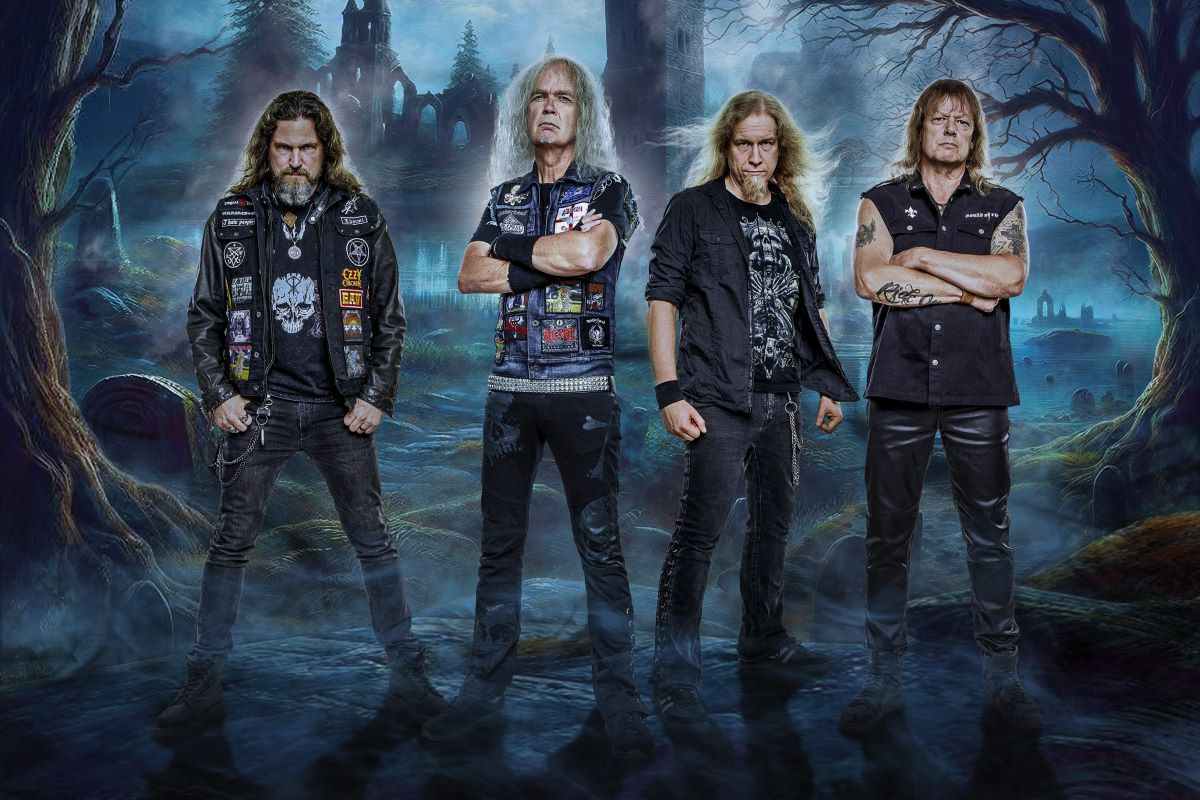
‘Bone Collector’ sees German heavy metal institution Grave Digger focus on their strengths: simple heavy metal songs with meaty riffs and catchy choruses. It seems the arrival of former Orden Ogan guitarist Tobias Kersting has done the band well. Singer and sole remaining founding member Chris Boltendahl talks about the collaboration with Kersting, as well as his love for clichés.
“Tobi was also the guitarist for my solo project, Chris Boltendahl’s Steelhammer”, Boltendahl explains. “That was the first time we worked together for a prolonged period of time, and the first time we experienced how well we worked together. So when Axel Ritt left the band, it was fairly obvious to me that I ask Tobi if he wanted to join.
After that, we started writing songs for the new Grave Digger album fairly quickly. I often sang riffs to Tobi, that’s what I did with Uwe (Lulis, former guitarist) and Axel as well. Tobi is actually a real old school guy. When Orden Ogan drifted into a more commercial power metal direction à la Sabaton or Powerwolf, that wasn’t really a thing that he wanted to do, so he left.
I would say that we have found a pair of shoes that fits very well. Tobi and I get along very well. There’s a very respectful friendship there. It’s been a lot of fun.”
Switching Things Around
Now that Kersting is a part of Grave Digger, Boltendahl doesn’t regret saving some of the material that ended up on the Steelhammer album ‘Reborn in Flames’ (2023) for ‘Bone Collector’ or any future Grave digger releases. “It’s not like we’re constantly writing new material for multiple albums with the guys”, he says. “We wrote completely new material for the album. Tobi and I wrote about eighty percent of the album together, and Jens Becker contributed to two songs: ‘The Devil’s Serenade’ and ‘Killing Is My Pleasure’.
In the end, though, it’s always a group process. We give the guys the parts, we talk about how everything works, about the feel a song should have, and they add their own attitude to the whole thing. There are always changes once we start working on the pre-production. With modern studio technology, there are a lot of options to switch things around. That’s definitely very different than it used to be.
Right up until the mastering process, you can switch things around whenever you think it necessary. The song structures are usually around ninety-five percent finished when we start recording. Everyone more or less has their own studio these days. I have my mixing and mastering studio, and that’s also where I record my own vocals. The guys send me all the tracks, and then it all comes together here, when I mix and master everything.
Everything has become much easier these days. Back in the day, when you knew what the budget was, you could book a studio for three or four weeks, and that was the time when everything needed to happen. Very limited, and when it’s done, it’s done. The studio owner is fifteen thousand euros richer, you are fifteen thousand euros poorer, and you have a record in your hands.”
An Appreciation for Live Music
One notable aspect about ‘Bone Collector’ is that it’s extremely light on keyboards. Despite the press release proudly stating that it’s the first Grave Digger album without any keyboard passages, Boltendahl insists that this wasn’t a conscious decision. “It simply developed that way”, he clarifies. “With keyboards, you can create an atmosphere that sounds big. Like we did with ‘Tunes of War’, ‘Excalibur’, or ‘Knights of the Cross’, where we employed keyboards in the choruses. We really inflated those choruses as epically big as we possibly could with those choirs.
But we never really did that on stage. On a song like ‘Dark of the Sun’ or ‘Rebellion’, we never really did those choirs live, because it wasn’t possible to reproduce it. We could have brought a computer that plays the choir and keyboard parts. But that’s simply not the type of band we are. Manual labor is a high priority to us.
I realize that does make us stand out as a band. If you play before or after a band that has half of the music come from a backing track at a festival, and then you come on stage to play music with only your regular instrumentation; sound-wise, you just can’t compete with that. But this is what I grew up with. This is how I experienced live music my whole life.
When you went to see Rainbow back in the day, there weren’t any backing tracks either. Or Judas Priest, who still don’t use any backing tracks these days. There are plenty of bands that sound exactly like they do on their cd’s live, and it does get difficult to equal that. But I think there are lots of people who don’t want to hear that either. There will always be people who appreciate that there are bands who still play live music.”
Signature Sound
“On ‘Bone Collector’, we wanted to have the vibe and the spirit of the eighties, even though we didn’t want it to sound like it was recorded in the eighties. That sort of retro stuff is not what we are about. That’s not Grave Digger. There are a few retro bands that I like that sound like Led Zeppelin or something, but I don’t like it for Grave Digger. I like modern productions that sound slightly retro. Marcus (Kniep, drummer) played a very old Ludwig drum kit, and I think you can hear that.”
Despite the different approaches Grave Digger employs for album to album, they have a very clearly identifiable core sound. “My vocals are an important part of that identity, of course”, Boltendahl state. “But I also play close attention to the guitar sound being somewhat similar throughout our releases. Sure, there are different people playing the instruments, but in the end, everything has to sound so that people think: this is the Grave Digger sound that I like so much. We put a lot of work into that.”
That also means Kersting’s entry into the band was a relatively easy process sound-wise. “It’s relatively simple for us”, Boltendahl says. “For the recording process, we take a Marshall, and a very old, yellow Boss overdrive. That’s Grave Digger’s signature sound. I have found a back-up of that small, yellow overdrive pedal on the internet. They cost a lot of money these days. But I think it’s worth it. That crispy bite in the guitar sound is the result of that overdrive.”
Marathon for the Vocal Cords
Boltendahl’s gruff, throaty voice has stood the test of time remarkably well, especially given the fact that Grave Digger has been around since 1980, and Boltendahl has just reached the age of 63 two weeks before the release of ‘Bone Collector’. “The funny thing is: I can’t explain how that has happened at all”, he admits. “I don’t drink alcohol or smoke pot anymore these days, I actually don’t smoke at all… That voice just shows up when I’m in the studio or when I go on stage.
As soon as I start to sing, that voice is there. You’ll notice that I can speak in a relatively normal manner. I don’t speak like Chris Boltendahl the singer. I can switch to the singing voice quite easily. It doesn’t feel like I’m forcing anything at all. I do have to say: the longest run of shows we ever did was nineteen shows without any off-days. That was a true marathon for my vocal cords. That’s when I started thinking: maybe we should start planning things a little differently.
You couldn’t hear the difference though. But I did notice my speaking voice getting a bit more hoarse. I do have to admit that it takes a little longer for the singing voice to appear near the end of such a long run. It might not be a hundred percent for the first song, but once we get to the second or third song, it’s there again.”
That does seem to suggest that there is proper technique involved. “Unknowingly”, Boltendahl smile. “But if I was able to explain it, someone else would do it, and I wouldn’t have a signature voice anymore, haha! Maybe you should ask Udo (Dirkschneider) how he does it. Although he kind of speaks the way he sings as well…”
Return of the Coffin of the Reaper
Some of Grave Digger’s most beloved releases are concept albums about historical wars and mythology. According to Boltendahl, the process of writing a concept album is significantly different than writing a more straightforward Grave Digger album. “When we decide a new album is going to be a concept album, then the story, the so-called concept, is what we start with”, he explains. “Everything else is geared towards that: the atmosphere, the songs, and of course, the lyrics have to be in service of the concept. Which, in all honesty, isn’t always that easy. Especially if you want to create heavy metal lyrics out of it.
We have often done that, and it always worked out well, and it was always a lot of fun to do. But this time, I said: let’s simply write lyrics that don’t have anything to do with a concept. The essence is the bone collector, the reaper. But of course, we already have an album called ‘The Reaper’ (1993), we’ve got ‘Return of the Reaper’ (2014), so we didn’t want to call this one ‘The Return of the Coffin of the Reaper’ or whatever.
So that’s why we thought: let’s try to find a synonym. That’s where ‘Bone Collector’ came from. I think it’s cool. When you hear the first song, ‘Bone Collector’: he’s the bone collector, the death protector, he’s the grave dictator… That’s already three names that we can use to name albums. We’ll see.
It’s a cliché. And I like cliché’s. I grew up with clichés. With the typical heavy metal attitude. Heavy metal lyrics like ‘Jawbreaker’, ‘Black Sabbath’, ‘Iron Man’, and things like that. That’s what I grew up with, and of course, that has become an influence on my own lyrics as well.”
A Fourteen-Year Coincidence
Kersting joining Grave Digger has provided the band some additional possibilities for playing their old material live. “Axel Ritt couldn’t really play the old songs they actually were”, Boltendahl admits. “Especially the solos. That was a completely different style for him. Tobi plays the solos much closer to the way they have been recorded for the albums. Our audience would really want to hear the original ‘Excalibur’ solo for the first time in fourteen years, so that’s something they will really enjoy. When we rehearsed with Tobi for the first time, it gave me goosebumps to hear him play the solo like Uwe Lulis did. That was simply awesome.”
Nevertheless, Boltendahl is quick to point out that this did not contribute to Ritt’s departure. “If that was the case, he would have been gone within two years”, he states. “In the end, the creative output between Axel and me was simply exhausted. There wasn’t much that was coming out, and we didn’t want to start re-heating old things and repeating ourselves. So that’s when I said: let’s try something else.
You can hear it when you listen to Axel’s new project Jäst, which is more or less the kind of music that he likes. He was never a real metalhead. He felt more at home in hard rock. It was more or less a coincidence that he ended up joining Grave Digger. And that coincidence ended up lasting fourteen years. Tobi, on the other hand, is a real metalhead.”
Something from Every Era
Speaking of playing live, with a band that has been around for as long as Grave Digger has, compiling setlists can be quite the challenge. “We have brought back a couple of songs we haven’t played in a while, or that we may not have played live at all”, Boltendahl says. “Like ‘The Keeper of the Holy Grail’, ‘Under My Flag’, and ‘The Grave Dancer’. We also play three new songs, and of course classics like ‘Excalibur’, ‘Rebellion’, and ‘Heavy Metal Breakdown’.
Those will always be on the set, of course. If we don’t play those, we will probably be removed from the stage. We always try to play something from every era of the band. We’re also playing two songs we wrote with Manni (Schmidt, former guitarist): ‘Valhalla’ and ‘The House’. Songs that always work well.”
Those eras in Grave Digger’s history often seem to start with a new guitarist bringing a new spark to the band. Including the fairly underrated ‘Ballads of a Hangman’ (2009), which is the only Grave Digger album featuring two guitarists. “Thilo Hermann is truly a fantastic guitarist, and a very pleasant person to work with”, Boltendahl emphasizes. “It’s a shame that it didn’t work out with him and Manni.
He greatly contributed to ‘Ballads of a Hangman’, also in terms of riffing. But in the end, we had to choose between him and Manni. But a year later, he was gone as well. It’s weird how those things go sometimes.”
Finding the Time
Now that Kersting has joined Grave Digger, the logical conclusion might be that Chris Boltendahl’s Steelhammer is over. “We have been talking about it”, Boltendahl assures. “We just have to find the time for it. At the moment, Grave Digger takes up all my time. I do interviews all day, then the tour will come, which we have to prepare for as well. I do management for the band and run the entire business side of the band, so we’ll have to see where the journey takes us.
We want to release an EP with Grave Digger in the summer, for Wacken Open Air. We have already written two new Grave Digger songs for the next album. There are always new plans. As long as we’re still healthy enough, we will always be doing something.”
 Kevy Metal
Leave a comment