
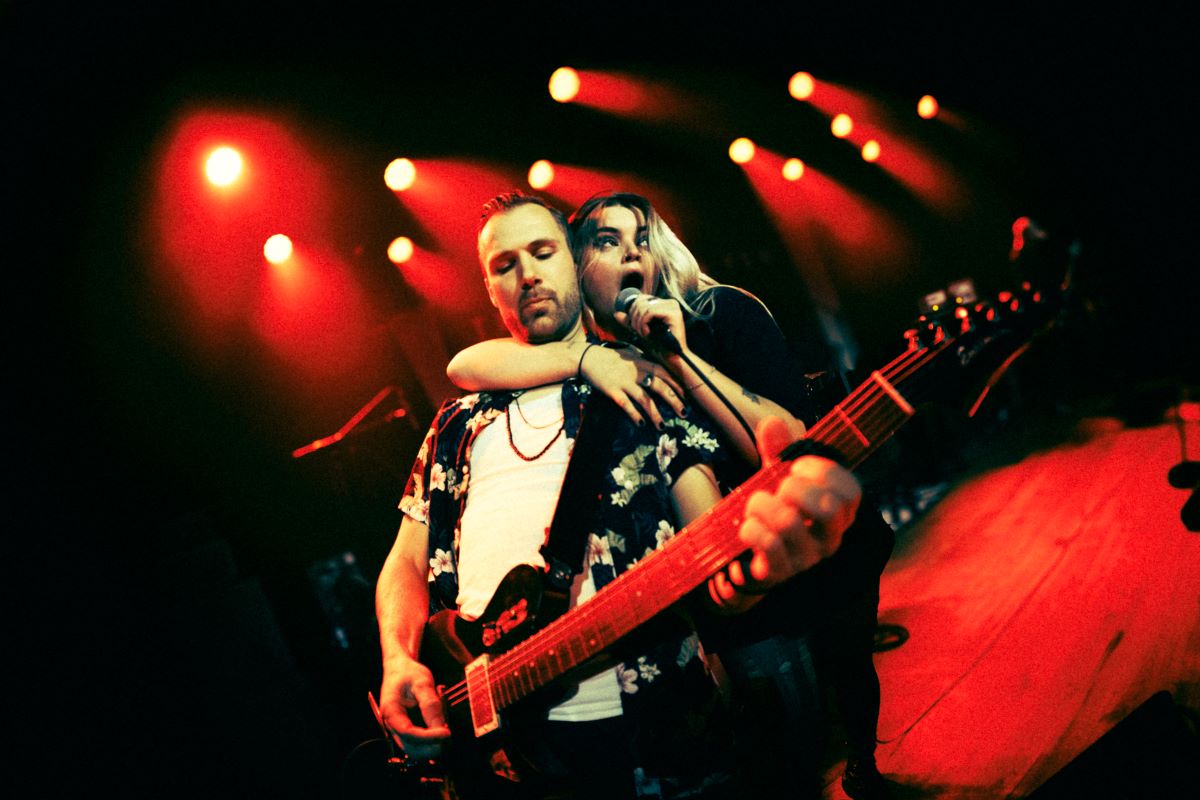
In a contemporary rock scene full of bands overthinking every step of their production process, it’s a good thing that bands like The Damned Few exist. After two excellent EP’s, the Dutch quartet’s first full-length ‘Karabasan’ is brimming with blunt, concise songs and energetic playing. Singer Dion Legebeke and guitarist Michiel Jansen explain how spontaneity is an important part of what makes The Damned Few the band it is.
“My original intention was to do a sixties, seventies sort of thing with the band”, Jansen admits. “But that plan failed in the best possible way. Because that’s not what it became. One reason for that is the fact that we’re all cut from a different cloth. There is a lot of common ground there, but I might be a bit of an old fart when it comes to my musical preferences. I really love seventies rock and blues rock. But Jaap (Schrijver, bassist) is a stoner dude, and Dion’s taste is very broad. We never even discussed genres.”
“Or: we don’t have this type of song, let’s do something like that”, Legebeke adds. “That conversation also never happened. Whatever we think is cool will make it onto the albums and the setlists, and if someone else likes it, that’s great.”
“We also have a bunch of songs that never made it to the album”, says Jansen. “And that’s a simple matter of the songs being too funky or too bluesy. Good songs, but we know Jaap isn’t exactly looking forward to playing that sort of music. We won’t do that to each other.”
Keeping Things Short and Fresh
“One thing we do like is songs”, Jansen continues. “Some guitar music approaches songs like platforms for a guitar solo. That’s not the type of thing we are after. I am probably most likely to try different things or spend some time working things out. But it’s good that we force each other to keep things short and fresh to keep the energy. If you start rationalizing things to death, the magic will disappear.”
“It just shouldn’t be too difficult”, Legebeke elaborates. “Not so much in terms of playing, but a song shouldn’t be too difficult to digest. Not even necessarily for the audience, but it has to be something that we enjoy. The song just has to make sense. It has to be pleasant to the ear, and the story has to be just right.”
“We had the same philosophy while recording the album”, Jansen says. “Guido (Aalbers, producer) didn’t tolerate recording a hundred takes until we have the perfect one. The perfect take simply is the one that best fits the intention of the song. That is an extension of how we write songs, as we tend to just let it happen. If something isn’t there, we’re not going to force it.”
“The riff in ‘Is It Love or Am I Sick?’ has existed for a long time”, Legebeke illustrates. “Honestly, for years. We once wrote a completely different song around that, with a half-time beat that just didn’t work. So we put that one aside, until Jeroen (Hobert), the drummer who recorded the drums for the album, joined us. Michiel played that riff, and Jeroen played a normal time thing, and suddenly, the song worked. I had a bunch of lyrics that I once wrote lying around, and it just fit. It just has to be there. Otherwise, you need to throw it away, or leave it on the shelf for a long time.”
Paradise on Earth
“Both ‘Soul’ and ‘Is It Love or Am I Sick?’ existed before our first EP (‘The Dirt’, 2018)”, Jansen explains. “But both were terrible songs, because we tried to force something. What often happens is that you are very enthusiastic about a riff, a chorus, or whatever, and then you feel like you have to make a song out of it. But if it’s not there immediately, we don’t want to force something that isn’t there to begin with.
Keith Richards has a vision about it in his memoir (‘Life’): the songs are there already, you just have to tune your antenna to them. Because they will run away if you try to force it. When we are in the rehearsal room, we never talk about: you have to do this, or: do I have to do this? We tend to talk very little while writing songs anyway. If it doesn’t work, we just stop. ‘Someday’ probably fell into place in about twenty minutes.”
“I had made something, simply a verse and a chorus”, Legebeke continues. “I know how to play guitar, but I’m nothing like Michiel. I can do whatever I need to do to be able to write a song, but I leave the rest to him. When I sent him what I had come up with, I immediately said: this feels good. That’s when we took it to our rehearsal place, which is really just a bunker. It’s got a fridge full of beer, so that’s where we go to smoke and drink.”
“It’s paradise on Earth”, Jansen smiles.
“A very nice place”, Legebeke nods. “Before we started rehearsing, I played the basic idea on a little acoustic guitar, then we started playing it together, and I think we had a song after playing it twice.”
“Our issue is usually: what do we do after the second chorus?”, Jansen admits. “That’s where you make the song by breaking it. ‘Someday’ had a very positive message: things suck now, but they’ll probably be better soon. That’s when we thought: we should end up in a bad dream or something right now. I don’t know how that happened; it wasn’t a riff I had prepared or that was stuck in the back of my mind somewhere, but that whole section with the slide solo didn’t exist at first. And then suddenly, it was there.”
Two Weeks to Learn
That slide solo, however, is where the bad dream began for Jansen. “Dion had written the song in G, with three chords”, he says. “I thought that I couldn’t get away with a song that just had three chords, so I figured I had to try something else. So I had the idea of putting my guitar in open G. That’s a fairly standard slide tuning, but the thing is: I don’t actually know how to play slide guitar. I had a slide in my guitar case, so I started messing around with it a bit. The rest immediately loved it, but I said: I can’t record it like this!”
“Oh yeah, you felt hopeless!” Legebeke exclaims. “We were all like: let’s do this! And your reaction was: I can’t even do this. We even got mad at you: come on, dude…”
“Keep in mind that this was literally two weeks before we went into the studio”, Jansen emphasizes. “And that was literally when I played slide guitar for the first time. So I had two weeks to learn how to play my own song. Imagine how a guitarist who is just starting out sounds when he practices: that sounds horrible. But someone who practices slide for the first time is just beyond unbearable. If you don’t hit the note, it sounds like a dying cat.
So I locked myself in the pantry with a small practice amp and a slide. And I think I have to thank my girlfriend for bearing with me those days, because I’m fairly sure it fucked up some of her evenings. It kept me awake for days. But it eventually made it onto the album!”
Not Too Many Expectations
The situation with the slide solo on ‘Someday’ might be the clearest example of Jansen being the most likely The Damned Few member to prepare and work out things. “If I go into the studio, I do prefer to have the certainty of at least knowing that I’m prepared”, he nods. “Dion is the exact opposite. She just goes in and does what comes to her naturally, and she always delivers.”
“The strange thing is: preparing is the thing that would make me insecure”, Legebeke explains. “If I rehearse something to the smallest details, I get the idea that there’s a right way and a wrong way to do it. If I don’t prepare anything, or if I haven’t set up some kind of bar for myself, that’s when I have the feeling I can just let go. Otherwise, I will have too many expectations for myself. It’s the same when we practice songs during soundchecks.”
“She never prepares”, Jansen laughs. “She just lights a cigarette and goes on stage.”
“Recording is a similar thing”, Legebeke continues. “It never takes me a long time, simply because it just has to be there. I don’t have time to get into it. Or technically I do, but I don’t want to make time for it. During the final recording session, I didn’t have a chorus for ‘Feed Me to the Sun’. I did have something, but it didn’t feel right, so we just stopped. We had one more day, and I do trust myself to come up with something the next day if I have to.”
Perfectionist and Going with the Flow
“Dion always delivers whenever she needs to”, Jansen assures. “We were just talking about ‘Is It Love or Am I Sick?’. We had finished the song instrumentally, but Dion hadn’t finished writing lyrics yet. So we told her: you do have to hurry up, Dion. We’ll just throw it on the setlist for next Saturday. She ended up finishing writing the lyrics on the bus, on the way to Enschede, haha! Playing the song on stage was the first time we heard what she was going to do with it.”
“It always works out”, Legebeke nods. “I am a lazy sod, but in the end, it will all work out. And if it doesn’t, we will throw it away and think of something else. What we do is cool, but in the end, it’s only rock ‘n’ roll.”
“It’s about spontaneity, isn’t it?”, Jansen asks.
“Yes, and about having fun”, Legebeke says. “And that it makes people happy. And ourselves.”
“One thing I do find important is that the humanity isn’t edited out”, Jansen puts forward. “That it doesn’t become a sterile studio production. Other guitarists always sound cool when it’s sloppy or nonchalant, like Keith Richards or Jimmy Page. But when you do it yourself, you can’t handle it. Guido, our producer, was always very harsh with it. He would say: this is what you played, so you better learn to live with it. I think that has ultimately benefited the results.”
“I think it’s a good combination of being perfectionist and going with the flow”, Legebeke adds. “When I listen to my vocal takes, I can be quite the perfectionist. If I hear something I don’t like, something someone else might not here, I want to re-do it as well. It’s not like we like things to get us off easily. It has to sound right.
When we did ‘Thrash Metal Disease’, I didn’t know I could even do that with my voice. I’m used to just sing. I didn’t know I could scream. Then I tried it and it turned out to be pretty cool. I used to want to be able to do it, but I thought my voice wasn’t strong enough for rock ‘n’ roll. But it’s really just a technique. Everyone should be able to do it. It’s just a matter of finding the right register.”
Three Sessions
“We recorded the album in three sessions”, Jansen explains. “Every time we had saved up a bit of money again, we would book a weekend with Guido to record three more songs. If I look at how things went, I think we have gotten more relaxed with it as we went along. I took a lot of time and effort to prepare the first session. That was ‘Someday’, ‘Til Death Do Us Part’, and ‘Break Up with Your Girlfriend’.
After that, things gradually got easier. For the last session, I think we wrote the songs one evening about two weeks before we went into the studio, then rehearsed the songs and fine-tuned the arrangements on the second night. And then we went into the studio, and we just let it happen. And I think that the songs we recorded during that session have become the best songs.”
“Yeah, that’s how I feel about that last session as well”, Legebeke says. “As far as you can have favorites, those have become my favorites.”
“Those are my favorite songs, and they don’t even have any guitar solos”, Jansen smiles. “We recorded ‘Feed Me to the Sun’, ‘Soul’, and ‘Thrash Metal Disease’ during that last session. Those are also the ones that came out best sound-wise.
For the other sessions, I also took a lot of stuff with me. That’s when you start trying out lots of different things, all of which distract from the essence, of course. For the second session, I just brought two amps and the JHS Kilt that I always use live. I basically used my live set-up. That’s what ended up sounding best.”
A Joy to Work with
“The basic tracks were recorded live, and we recorded overdubs and vocals over that”, Jansen says. “Every song has the band playing together in the room as its foundation. Most times, we would do five rounds per song, and then the basic tracks were done. Jeroen was usually done after one take. That man is a machine.
Jeroen has played in a lot of big bands: Prodigal Sons, 16 Down, he toured with Bökkers for years. On our side of the country, Bökkers is truly larger than life. When he quit Bökkers, Ruud (Thijs), the producer of our previous EP (‘Black Hearted Woman’, 2021) said: why don’t you ask him? And we said: someone like that is never going to play with us.
He lives right around the corner for me. So at some point, I just sent him a WhatsApp message, and much to our surprise, he said: yeah, of course! It’s unbelievable how good he is. Everything he plays just sounds good. It’s got groove, even up-tempo things. He is simply a joy to work with. He doesn’t say much, but if he says something, he is right. And he is also someone who can just let things happen, so that worked very well with our music.”
Boosted Over the Top
“Nearly all of the guitars I use on the album are Eastman guitars”, Jansen explains. “The only non-Eastman I used was a Telecaster by Haar Guitars. You always need a Tele in the studio. Everything sounds rock ‘n’ roll with that thing in the mix. While I prefer to play with humbuckers on stage, I like playing certain things with a Tele on the record.
One of my Eastman hollowbodies has those TV Jones-esque pick-ups by Lollar. Most of the Eastmans have humbuckers, and then there’s one Les Paul Junior-style guitar with P90’s. A really cool sound. It sounds so rude. It’s that Leslie West thing. One of the best guitar sounds ever. It’s kind of an attitude. You have to do it with your fingers, because there are no knobs or extra pick-ups. It’s very freeing to play with that thing.
During the recording of ‘Break Up with Your Girlfriend’, I used a Vox AC30 which didn’t make the rest of the session. I basically boosted it over the top with a treble booster, like Brian May and Rory Gallagher did. When you do that, the amp is simply boiling hot. It has these plastic grids and those nearly melted. It was unusable after that recording. The valves were simply finished.
‘Soul’ ends with a note that keeps ringing endlessly until I put my foot on the pedal. We soundchecked which pedal sounded best. The Deep Trip Hellbender, which is the pedal with the largest enclosure, eventually had the best acoustic sound. That’s what ended up on the album.”
 Kevy Metal
Leave a comment