
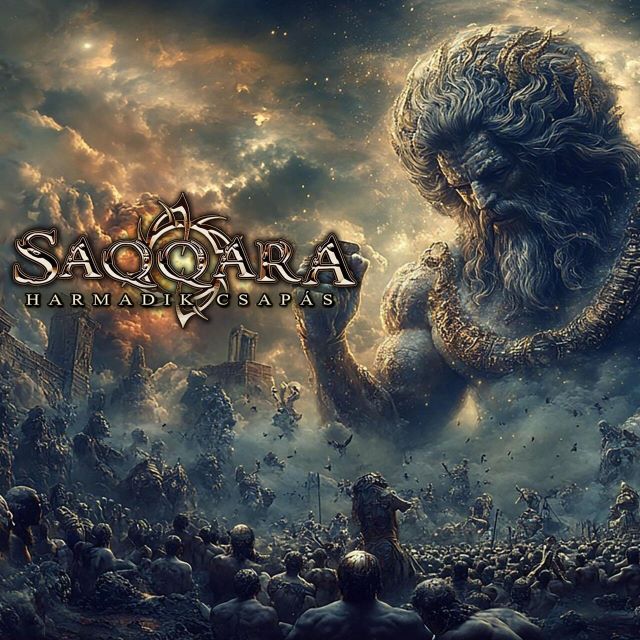
Saqqara was once brought to my attention when a promo of their second album ‘Második Csapás’ was included with an order from Hungary. It was promising enough, but since it is over five years old at this point, and there was only a year between their first two albums, I just assumed they had broken up. Fortunately, their third strike – which is what the album title translates to – is now upon us, and it is a nice slab of adventurous, at times surprisingly atmospheric metal. If you like your metal with an epic storytelling vibe, ‘Harmadik Csapás’ is a must-hear.
Classifying ‘Harmadik Csapás’ as anything beyond just “metal” is difficult. How the keyboards and the guitars interact gives some of the songs a distinct proggy edge, though I hesitate to call Saqqara a progressive metal band. The rhythms are pretty much exclusively in 4/4 and the songs clearly go for enveloping listeners with their atmospheres rather than beating them over the head with an abundance of changes. Also, guitarist and main songwriter Viktor Nagy seems to have gotten a lot of inspiration from Middle Eastern and North African traditional music, but never gets as ham-fisted about it as the average folk metal band.
Despite not sounding remotely similar, the songwriting philosophy on ‘Harmadik Csapás’ occasionally reminds me of ‘Twilight of the Gods’-era Bathory. The way the melancholic lead guitars and wide chords appear to emulate the vastness of nature in ‘Mikor Eljön Az Éjszaka’, or how relatively simple keyboard melodies color the overall atomsphere of ‘Halottak Könyve’ feels distinctly Bathory-esque, but in compact, mid-tempo power metal songs. Album highlight ‘Út a Fény Felé’, on the other hand, goes all in on the North African folk elements with its gorgeous strings and percussion enhancing the excellent, surprisingly heavy riffs.
Elsewhere, Saqqara proves that dazzling complexity is not required to subvert a listener’s expectations. ‘Soha Nem Adja Fel’ starts with a keyboard line that suggests the AOR-influenced sound that ruined a lot of recent prog metal releases, but actually evolves into a beautifully melancholic metal song with a powerful low-end. ‘Végítélet’ initially comes across as a power ballad, but turns into a very dynamic metal song. Less misleading, but every bit as good is ‘Penge Élén’, which slightly reminds me of Ignea in how its East Asian folk elements are prominently featured without getting in the way of the metal riffs and melodies.
Maybe ‘Harmadik Csapás’ needed to be five years in the making. Saqqara simply sounds more confident here than on ‘Második Csapás’. The playing is tighter, the arrangements feel better put together, and the band as a whole seems more certain of what they want to be. What exactly that is, is not easy to describe, but if you think a band that combines power metal riffs with folky, cinematic, and progressive overtones in mostly mid-tempo songs is right up your alley, Saqqara is worth checking out. ‘Harmadik Csapás’ definitely sounds close to the album I thought Saqqara would be capable of making after hearing its predecessor.
Recommended tracks: ‘Út a Fény Felé, ‘Soha Nem Adja Fel’, ‘Penge Élén’
 Kevy Metal
Leave a comment