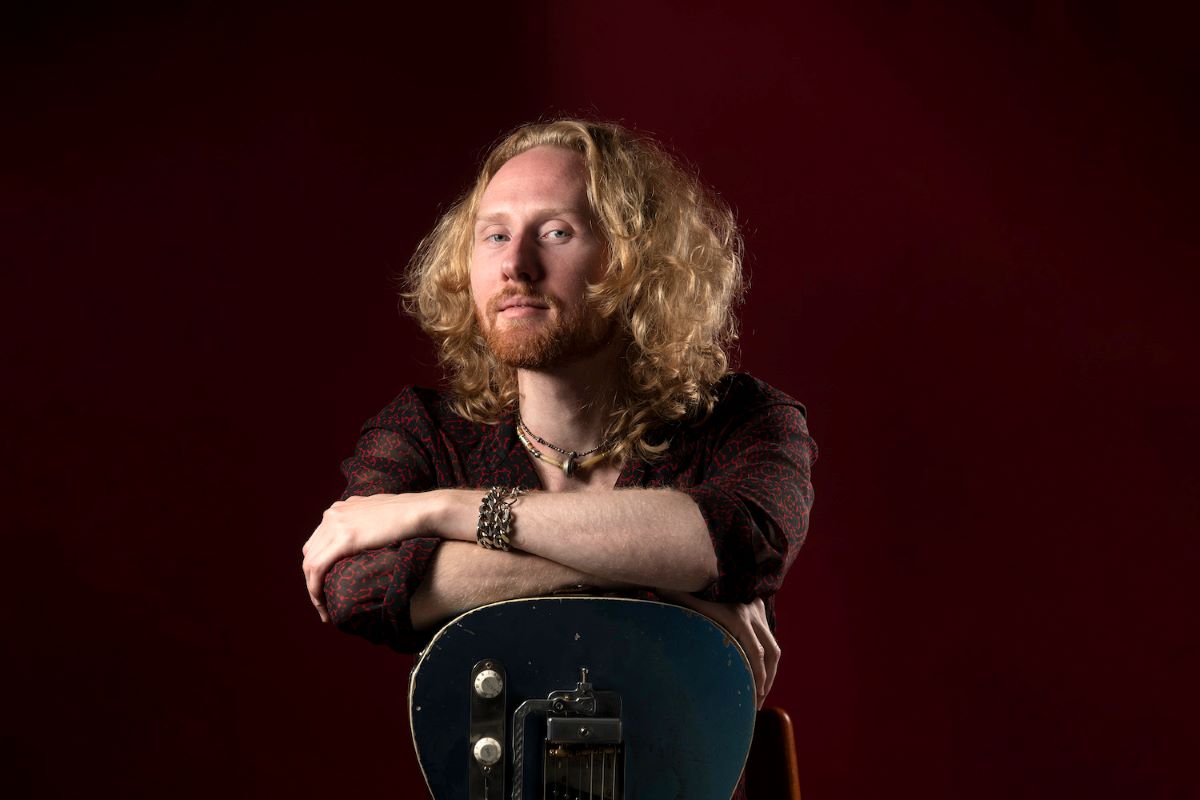
The introduction to his new release ‘Self-Education’ says it all: Dutch guitarist Theo van Niel Jr. mixes rock, country, folk, jazz, classical music, and heavy metal to create a completely fresh take on instrumental guitar music.
“I did try to push this record into rock territory a little more”, Van Niel admits. “So that it will be a little easier to market. If people ask me what it is, it would be best if I could give them a clear answer. I tried to keep rock as the foundation of it, with some excursions to different genres. That does keep things fresh, and it is something I like to do to challenge myself. I also suspect that that’s where the gold is when it comes to finding your own sounds and trying to push the boundaries.
Looking for your own voice is something that isn’t done as much as it maybe should be these days. Music often has to be categorized, because that makes it easier to sell. But if you look at the biggest heroes in music history: they were all looking for something unique, their own thing, their own voice. That’s what I’m trying to do within the scope I operate in.
Tackling all these genres isn’t a show-off thing. I am genuinely interested in all of those things. Sometimes, it might be a little strange or inexplicable how I mix styles, but it is important to me that I can insert a lot of feeling into it. If you play something, you have to do it well. Then you have to really immerse yourself in it.
It’s a way of connecting to your instrument, a way to translate what you hear in your head to the instrument as well as possible. Not thinking too much, but feeling as much as possible.”
Between Virtuosity and Melody
Part of Van Niel’s musical education is rooted in the cd store Rocky Road in the center of The Hague, which his late father used to run. “I grew up in my father’s cd store, and during a certain time, the releases from Mike Varney’s Shrapnel Records were very popular”, he explains. “One amazing guitarist after the other I discovered this way: Greg Howe, Paul Gilbert, Michael Lee Firkins, Vinnie Moore, Ritchie Kotzen, and of course Frank Gambale with Allan Holdsworth.
Especially the ‘Truth in Shredding’ album with Frank and Allan stuck with me. The first time I heard Frank Gambale’s solo in the opening track ‘Rocks’, I was blown away. If you truly scrutinize what he is playing, you can spot a few minor mistakes in Frank’s solos, but he really went for what he could do in one take, which is something I greatly respect.
Allan sounded like an alien to me on that record. Absolutely incredible, but Frank’s playing was something I could connect with a little more. I can literally dream his solos from that record, and his nineties work is probably my favorite work of his. To my ears, he managed to find the perfect balance between virtuosity and melody, with a great sense of build-up, and perfect levels of jazz and rock ‘n’ roll.
I never learned how to play like Frank, but he did inspire me, for example in the way I use sweep picking and economy picking. I have started combining that with a hybrid picking and chicken picking technique, which creates an interesting mix of styles for the right hand, allowing me to play things that would almost not have been possible otherwise.”
A European’s Own Spin
One of the things that sets Van Niel apart is the remarkably aggressive country-picking style of playing that is prominent on a lot of his material. “It’s just that I had this Telecaster, which I bought about twelve or thirteen years ago, and I just started plucking it naturally”, he smiles. “It’s not like I have country music playing here all day. Quite the contrary.
I started playing guitar when I was eight years old, and at the time, it was all acoustic fingerstyle things. So as a result, I did already have a foundation of those motor skills in my right hand. And somehow, I ended up combining that technique with playing the electric guitar later on, simply because it felt natural. Also, a Telecaster’s twang kind of demands to be plucked.
When I checked out country guys like Brent Mason or Scotty Anderson and true country monsters like them, it helped me realize which way I could go with my playing. And then I went my own way with it. So many things have been done already, but rock music with a bit of a country influence and something like a B-Bender: that’s not something you hear all that often.
Actual country guys from Nashville are incredible players, but they generally stay away from rock territory, unless it’s country rock, which is quite a different beast in itself. That way, I think my approach is more that of a European who puts his own spin on things.”
Finding the Flow
The fact that both ‘Self-Education’ and its 2017 predecessor ‘Practised Bravado’ were released alongside guitar transcription books seems to imply that Van Niel composes his solos. Nothing could be further from the truth, though. “It’s exactly the other way around”, he assures. “I transcribe everything after the fact, which can be quite the daunting task, haha! Sometimes I have to dig deep to remember what I actually played. Some of these songs go back to the covid days, and even before that, and I made all the transcriptions last year.
I am not the type of player who thinks ahead so far that I transcribe or work out everything prior to recording my solos. That often kind of removes the spark from it for me. However, ‘Self-Education’ is a bit more modern. Most of it I would categorize as modern rock. Within that idiom, solos are often somewhat composed. That is why I have thought out the solos a little more this time around, in the sense that they have a specific structure.
If it was a different project that was a bit more old school, I would probably have improvised a little more. Finding a certain flow can be a bit of a challenge. Especially when you are within your own home, turn on the song, and suddenly need to create something. It all depends on how creative you feel that day, and how much the song triggers for you.
Sometimes, when you want to combine that with a technical tour de force of sorts, you’ll have to practice a bit. It’s in your head, but it has yet to come out of your fingers. But sometimes, it goes really quickly as well. Then it’s done within two takes, except for maybe a few small things here and there.”
Not Bound to a Certain Style
Van Niel plays most of the instruments on his solo releases, but does enlist the help of experienced drummers. Thomas Lang, Dennis Leeflang, and Davy Andy Henket appear on ‘Practised Bravado’, while Shane Gaalaas plays on ‘Self-Education’. “Those guys are picked based on the fact that they are versatile and not bound to a certain style, playing-wise as well”, Van Niel explains. “People like Thomas and Shane are perfectly suited to that approach. It’s been a joy to work with those guys.
Most of the time, you can simply send them an e-mail. Some of them are easier to message than others. And then it’s a matter of seeing how they respond to my music. I often work with video, so I have a lot of videos of Shane recording the drums to those pieces. That way, we can truly work on those pieces together. It’s truly great to be able to do it like this these days. Shane has his own drum studio in Los Angeles, and I have my own place here, so everything is sent back and forth a couple of times.
But yeah, a lot of the foundation comes from me. We do have Jørgen Munkeby on saxophone on the opening track, and Shane on drums, but everything else you hear is me: bass, guitar, some keyboard things on ‘Ave Maria’, so the programming, and the synthesizers… That’s all me.”
Playing Around with Sounds
Given the wide range of styles and sounds on ‘Self-Education’, Van Niel’s set-up is actually surprisingly concise. “A lot of it is just my Panucci Telecaster”, he says. “Including the heavy pieces. It’s a very versatile guitar. If you play around with the different amp sounds a bit, you can nail quite a lot with the color a Telecaster gives.
There are some Les Paul parts here and there, which is my Goldtop that I have been using for a long time. I definitely used that for the slide parts in ‘Ave Maria’, because I think a Goldtop is more convenient for playing slide. Maybe I used the humbuckers of my Les Paul in combination with that Telecaster for some of the rock parts, but I can do a lot with those two guitars.
For the studio things, I tend to reach for my Kemper. That thing is just very convenient and efficient to work with. Also, it just sounds great. Especially for the rock things, so the gain sounds. It can be a bit more difficult with clean sounds, although the intro to ‘Ave Maria’ and all of ‘Sierra’ are quite clean, and those have also been done with that Kemper.
One thing I do play around with is making a combination of digital and analog. While the amp sound is digital, coming from a Kemper, I do tend to route the whole thing through an analog tape delay and a Fender spring reverb. So all the effects are analog.”
This interview is part of Kevy Metal’s Gateway to Jazz series.
 Kevy Metal
Leave a comment