
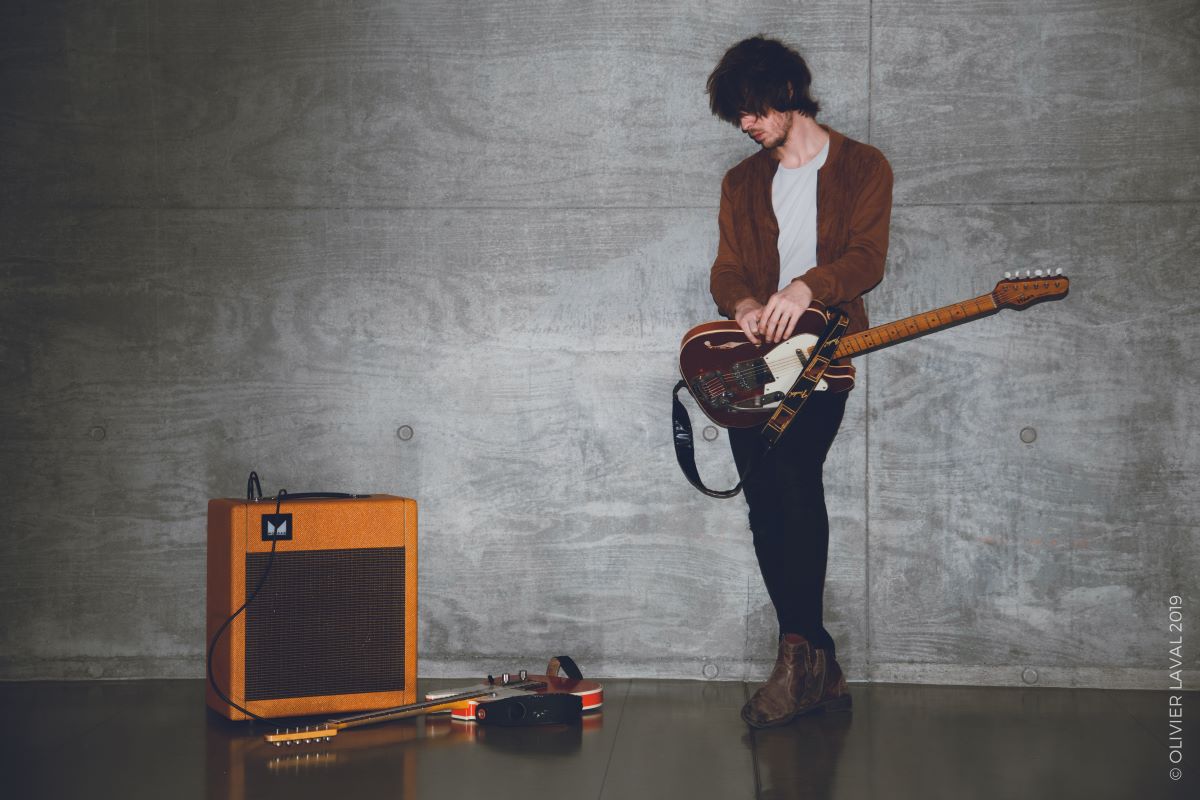
Folky sounds with Harvest Group, traditional jazz leanings with the LG Jazz Collective, full-on singer-songwriter with IAMWILL: Belgian guitarist Guillaume Vierset never wanted to limit himself to one particular style of music. His project Edges finds him exploring more distorted sounds, with its debut album ‘The End of the F***ing World’ finding middle ground between fusion, abstract progressive rock, and even a bit of pop music.
“Like many musicians, I asked myself a lot of things during the pandemic period”, Vierset explains the genesis of Edges. “And the first question I wanted to answer was: why am I playing music? What do I like about it? What excites me the most? I realized I was doing a lot of things that I didn’t like anymore, especially a lot of things that were blocking me as a musician, and the fact I didn’t always accept who I really am, both as a musician and as a person.
I decided to stop trying to force things musically, to get rid of any frustrations, and to accept my weaknesses and make them a strength. Edges gave me the strength to accept who I am, and for once, to go fully in a direction without putting up any barriers, without feeling the need to label it, and to completely immerse myself in this hybrid music. For me, Edges is the beginning of something. I’ve never felt so good about my music.”
Letting Go of Control
“Edges offers almost total freedom. I gave the musicians I worked with scores with just the melody and the harmony. For everything else, they had the freedom to come up with whatever they wanted. Before Edges, I used to compose almost everything, except the solos. I had a very precise writing process, and closed arrangements, because I wanted to have total control over everything.
In hindsight, I think that was a lack of confidence in me that I projected onto the other musicians. With time, I understood two things, which in my opinion are very important. First off: the more musicians are free to express themselves, the better they will play. If I hire Dorian (Dumont, keyboard player), AC (bassist Anders Christensen) and Jim (Black, drummer), it is for the way they play, their sound, their personality. For a personality to mark a record, to express itself, you need freedom, absolutely!
The second thing I realized is that there is nothing more exciting than letting go of control, and being completely into the music with others, not having your eyes glued to a score at all times. It is for these two reasons that I decided to give the musicians a lot of freedom, and it has become a new philosophy for me.
Some people say that a piece isn’t finished until the composer is dead, haha! I feel like a piece is finished when I see that it has a very clear color and direction. I feel like I can completely let go of control when the direction of the composition is so clear that we can all move in the same direction. The other aspect is the freedom that can be found within this framework, between the lines.”
A Landscape with Different Planes
“I have known Dorian for maybe fifteen years. We met at the conservatory, and I always knew that one day, we would play together. Musically, Dorian has taken a route quite similar to mine: we both have a jazz background, we love tradition, and we use this to create something else than bebop or swing. We have the same philosophy. Dorian also has this ability to color my music, and to choose sounds that go together perfectly with my guitar. He has this intelligence to see the music as a landscape with different planes.
About fifteen years ago, I was working in a very rock ‘n’ roll bar in the weekends to make some pocket money, and I was often listening to the Danish rock band The Raveonettes. I loved the sound and the bass lines of this band, especially live. A few years later, I discovered videos of guitarist Jakob Bro and Paul Motian’s Electric Bebop Band, and I was attracted to this bassist, AC. That’s when I realized that he is also the bassist of The Raveonettes. Unbelievable! That’s the sound I wanted on my record, with this guy!
Jim Black is one of the pillars of modern drumming. He brought something new to the world of jazz. He has a rocker’s touch, the openness of a jazz man, and a very singular vision of his music. I have always been a fan of his band AlasNoAxis. It was unthinkable for me to have the chance to play with him one day. That’s when the Marni Jazz Festival offered me a carte blanche, where I had a budget to choose a line-up and write new music for a one-off concert. I contacted Jim, and he accepted.
Jim gave me a lot: his energy, his vibes, his way of seeing things… He played a very important role in my vision of music. He changed me completely, and I am very indebted to him for that.”
Instant Composition
“While recording or playing live, I want everyone to feel good. I want every musician to be able to express themselves. I don’t want any frustration, I don’t want any stress; I want to listen to everything and enjoy the moment. That is one of the reasons why I really look for a clear direction and color in my compositions. It avoids a lot of questioning how to really make a piece sound the way it is supposed to; it saves time.
If the direction is not clear after one or two attempts, or if I feel that it’s difficult to get a certain color out of it, I throw it away instantly. I don’t keep it; it’s very rare for me to come back to a composition I once abandoned. I also like to keep things fresh, which is why I like it when things go fast. For this record, the first take was often the one that we kept.
My solos are all improvised, or instant composition. I don’t prepare my solos. On the other hand, I do take a lot of time practicing the chord grids. I look for new ways to play over these progressions. I have a lot of fun. I actually play with it. We still say “play the guitar”, let’s never forget it.
When we are in the studio, I do not think of anything anymore. I open my ears, and what will come out will come out, without forcing anything. It’s important to be relaxed in the studio, to listen to other people, and accept their ideas.”
Putting the Ego Away
“Playing a lot of jazz allowed me to develop a considerable knowledge of the neck of my guitar, to develop my harmonic ear, and my sense of rhythm. I practice this music almost every day. In my opinion, it is one of the best schools for learning music. However, playing other styles, such as rock, pop, soul, and folk, has helped me considerably to understand the place of a musician within a group: how to place myself in a soundscape, how to play in service of the music, how to make things better.
In a jazz context, there is often an ego that speaks: I’m a soloist, and in this place, I’m going to show what I can do. Playing in other contexts, I learned to put that ego away. I also learned a lot about sound. How to be discreet, while being there, and then to come out of the mix when needed for a note, a lick, or a chord.”
One of the songs on ‘The End of the F***ing World’ is called ‘I ♥ Triads’. What is it Vierset likes so much about them? “Simplicity, efficiency”, he summarizes. “In a jazz universe, chords are often built with four sounds, sometimes five or six, and they have a more complex density than triads or three-note chords. And I love when it’s simple. Three-note chords represent the first chords that I learned on guitar, like any guitarist. I don’t want to forget where I come from. Triads are sometimes so much fun for the guitar: they sound so good.”
Shaping the Sound
“I fell in love with Erik Haar’s guitars. I just ordered a third one. I love the playability of these instruments. On this record, I used a Haar Thinline equipped with two Bare Knuckle pick-ups. They have a rather vintage sound with a huge output. I play on an amp made by the Belgian manufacturer AMS. He made me 25-watt head with a 1×12″ cabinet with a Vintage 30 speaker. This amp allows me to play at a club volume and still approach break-up, just before it saturates.
When it comes to effects, I am a real geek, but I’ve gotten a clear idea of what I want. My philosophy is that less is more, and the fingers will do the rest, because the sound is primarily in the fingers, and not in the effects. However, in my configuration for Edges, I use an old Proco Rat from 1988 couple with a Hao Rumble Mod. Two pedals that are hard to find, but that I love. These two pedals shape my sound.
Also, there are two pedals that are always on: a Strymon BlueSky for the reverb, and an Empress Vintage Modified Superdelay. With these four pedals, I modify some presets. Especially the delay, depending on the song. For example: on ‘First Round’, I have a rather long delay that gives a little thickness to the sound. And on ‘Gloomy’, it is rather a slapback to tighten the delay. Apart from the pedals, I use all three different pick-up positions of my Haar. And my fingers!”
Adapting to Needs
“Generally, I use the same set-up for my bands, such as Edges and Harvest Group, because they are my projects, and I try to defend my sound, my vision. When I play with Sharko or Typh Barrow, I have a different set-up than with the bands, because they require other sounds. For example: I have a pedalboard that is specially conceived for Sharko.
It is necessary to have a simple, but effective set-up. We are a trio, and therefore, the guitar has an important place in the music, and it asks for big dynamics with differences between the verses and the choruses. But that must remain simple, effective, and direct.
For Typh Barrow, I have a more complex set-up, which is more “produced”. With compressors, a lot of boosters, and the possibility to produce sound at any time. Basically, I try to be as versatile as possible. In my projects, I have my set-up. For other people’s projects, I try to adapt myself to their needs and those of the music.”
Another Mindset
“In general, I work per period. For example: at the moment, I am writing a second album for Edges, which is due for release next spring, and so my mindset is in the color I want for it. At the same time, I am in the initial phases of working on a solo project, which is the opposite of the work with Edges. I put myself in another mindset, and I manage to make the difference, which does not prevent having surprises sometimes.
In the near future, I would love to tour with Edges, and share this music with the audience. I also need to put myself in danger. It excites me; it makes me live. Sometimes, I also have the desire to play in a trio. I have it in my head, but I don’t know the color yet. It will come, but I must not wait too long, because after all, it’s the end of the fucking world.”
An edited version of this interview appeared in Gitarist 387 (June 2023)
This interview is part of Kevy Metal’s Gateway to Jazz series.
 Kevy Metal
Leave a comment