
Sepultura’s current ‘Celebrating Life Through Death’ world tour was announced to be their farewell tour. Guitarist Andreas Kisser looks back to forty years of Sepultura history, emphasizing that the tour should be seen as a celebration, but also has one eye on the future.
“The tour is going great!”, Kisser exclaims. “Really great vibes. Very emotional fans. We’re playing a very complete set, in the sense that it’s the longest set we have ever done. We play some songs that we haven’t played for many years. Some B-sides, or C-sides even.
We brought the ‘Kaiowas’ jam back. That’s something we did on the ‘Chaos A.D.’ tour, where we play the instrumental song, we put extra percussion instruments on stage, and we invite our friends and family and people from the crowd to join us on stage to jam with us, which has been amazing. Every night is a surprise. So if you go to any Sepultura show, be prepared! You could be called on stage to jam with us, haha!
We are enjoying ourselves the way it was planned to be: to really celebrate forty years, and to say this big thank you to all the fans that kept this band alive for so many years. It’s fantastic. We’re really celebrating. So we’re not saying farewell in a sad way, but in really high spirits, and we’re very thankful.”
Better by the Day
Remarkable is the fact that Sepultura was forced to bring in a new drummer for their farewell tour. Eloy Casagrande left to join Slipknot unexpectedly, and Greyson Nekrutman was brought in just weeks prior to the start of the tour. “Different drummers is the story of our lives, so what’s the difference?”, Kisser says with a wry smile. “It’s different to the way it was supposed to be, but I think Greyson brought a new energy, a new life. He brought the wish to be there with us.
He’s a very smart, very talented guy. He’s 22 years old, but he has a lot of baggage, a lot of experience behind him. And he is very interested in the songs and Sepultura’s background. He’s always learning new songs for us to have more choices for the setlist. He has a very strong connection to the fans; he likes to talk to everyone. It’s fantastic. It’s something that I think we needed, and we realize that now he’s here.
We are recording every show for a live album, and it’s getting better by the day. The versions are coming out very unique. We create a new Sepultura every day. We’re not trying to copy ourselves or reproduce something that isn’t there anymore. I think that’s how we’re still here after forty years. That’s why it doesn’t get annoying to play ‘Inner Self’ or ‘Troops of Doom’ every night.
Every ‘Inner Self’ is a new one, with a new crowd, a new atmosphere and a new performance. That’s the beauty of it all. Of course we reproduce the song the way it is, but many details have been developed over many years. Every song is our true performance of what the song is today.”
Exploring Dissonance
“Sepultura has always worked with the elements we had in our hands. We respect the characteristics, the ideas, and the styles of everyone who came into the band. Starting with me. When I joined Sepultura, I brought all my ideas, my lyrics, everything. And Sepultura changed. The same with Derrick (Green, singer). The same with Eloy, and Jean Dolabella (former drummer). If you are stuck in a specific era of your career, the artistic value is zero.
I always look at the guitar as a whole instrument, not divided into rhythm and solo guitar. For me, they are the same notes, just lower and higher. That’s why especially in the ‘Chaos A.D.’ days, I really went away from the normal leads and arpeggios, which I hated during those days, because everybody was doing that shit for no reason, in songs that had no reason to have anything like that in them. That’s why the leads on ‘Chaos A.D.’ are what they are.
I connected more to the rhythm patterns of the right hand, and exploring dissonance. Like in ‘Propaganda’, ‘Clenched Fist’, or that I started messing around with even on ‘Mass Hypnosis’ from ‘Beneath the Remains’. And doing so, I think I kind of created a new identity, not just for my guitar playing, but also for the Sepultura sound.
The rhythm guitar parts were always more important for me. It’s the foundation of everything. Before you start improvising, you have to embrace the rhythm parts. I’ve seen a lot of guitar players really only playing solos. Coming from the world of thrash metal, having guys like James Hetfield and Scott Ian, who have great right hands, I think there was always a lot of concern in getting the basics tight, so you can be a little more free on the higher notes.”
Creating a Language
Kisser’s right hand was an asset for the band immediately after joining. “I actually recorded a lot of rhythm guitar parts for Max (Cavalera, original vocalist and guitarist) on ‘Schizophrenia’”, he says. “Like ‘Septic Schizo’. The intro was kind of complicated for him to do. But it wasn’t like James Hetfield and Kirk Hammett, where Hetfield used to record all the rhythm parts. I don’t know if they still do that.
But us: no. Max and I used to do our parts together. And in doing so, we created kind of a language together. We were very tight playing together. We knew what our strengths and abilities were, but we also knew our weaknesses. There are two guitar players playing on those albums, with all their strengths and flaws, which makes it very special.
Although we weren’t going up and down the scales and trying to be virtuosos, we actually are. Because thrash metal is virtuosic music. You have to study, and you have to spend a lot of time with your instrument. That is the virtuosic aspect of that style of music. Like Slayer: that type of riffing is totally rhythm-oriented.”
A Whole Different World
The fact that Sepultura will soon call it quits does not mean that Kisser’s development on the guitar will end. “I’m studying more than ever!”, he exclaims. “I have always studied classical guitar; I never studied electric guitar. But I adapted everything I learned on classical guitar to heavy metal, alongside listening to my idols, learning with them by listening to their music and learning to play it.
My study now is more focused on this Brazilian style of music called chorinho, which is classical music with seven-stringed classical guitars. On electric, I couldn’t adapt to the seven strings, for some reason. When we first started messing around with lower tunings, around ‘Chaos A.D.’ and ‘Roots’, I had a luthier build me a guitar with seven strings, but I quickly decided to use heavier gauge strings instead. Using .013’s, which are very heavy, helps a lot to keep the tension right during fast-picking stuff.
But now I’m playing seven strings. In chorinho, the guitar is more part of the rhythm section of the ensemble. Because I have seven strings, I do more of the bass lines, lower parts, accompanying the lead and the rhythm section. It’s a whole different world. Of course, I know chorinho from people like Heitor Villa-Lobos, and many other composers who brought this street style of music to the classical halls. But now I’m getting deeper into the different rhythms of styles like chorinho and samba. It’s always great to see music in a different perspective, to get new ideas, and keep you motivated as an artist.”
Organizing Ideas
It should not be too surprising that Kisser takes the acoustic guitar seriously. Even as recently as the single ‘Guardians of Earth’ from their 2020 studio album ‘Quadra’, the classical guitar has a prominent role, and one of the two cd’s of Kisser’s 2009 solo album ‘Hubris I & II’ has an entirely acoustic foundation.
“That was a very difficult album to make”, Kisser admits. “It took many years. It was when Igor (Cavalera, original drummer) was leaving the band and Jean was joining Sepultura. Jean was even the drummer on a lot of the songs on that album. It was a great experience, though. I tried to play as much as I could. I recorded some bass on some songs, and all the guitars, even some vocals. Hopefully, I will have more time to develop more ideas like that now that Sepultura will stop. I have so much stuff written and recorded on demos and in ProTools that I have to organize.”
And then there is the Latin American supergroup De la Tierra, that Kisser plays in with A.N.I.M.A.L. frontman Andrés Giménez, Maná drummer Alex González, and Puya bassist Harold Hopkins. “We released our third album last year”, Kisser says. “Unfortunately, we couldn’t get together to jam and to tour, because we are very busy with our bands. Which is great; we’re not complaining, but that meant there was no room for De la Tierra, unfortunately. I’m very happy with the last album. I think it’s our best work. And I’m excited to hopefully soon put that on stage. I miss those guys.”
A Lack of Respect
Acoustic guitars aren’t the only notable guitars in Kisser’s arsenal, however. Aside from his new signature Jackson, he has been managing to make a Strat sound unusually heavy for over two decades. “I was skeptical as well when this Strat was offered to me”, Kisser confesses. “But then I remembered seeing Kirk Hammett using a Strat in the early Metallica days. So I gave it a try, and it really worked out great.
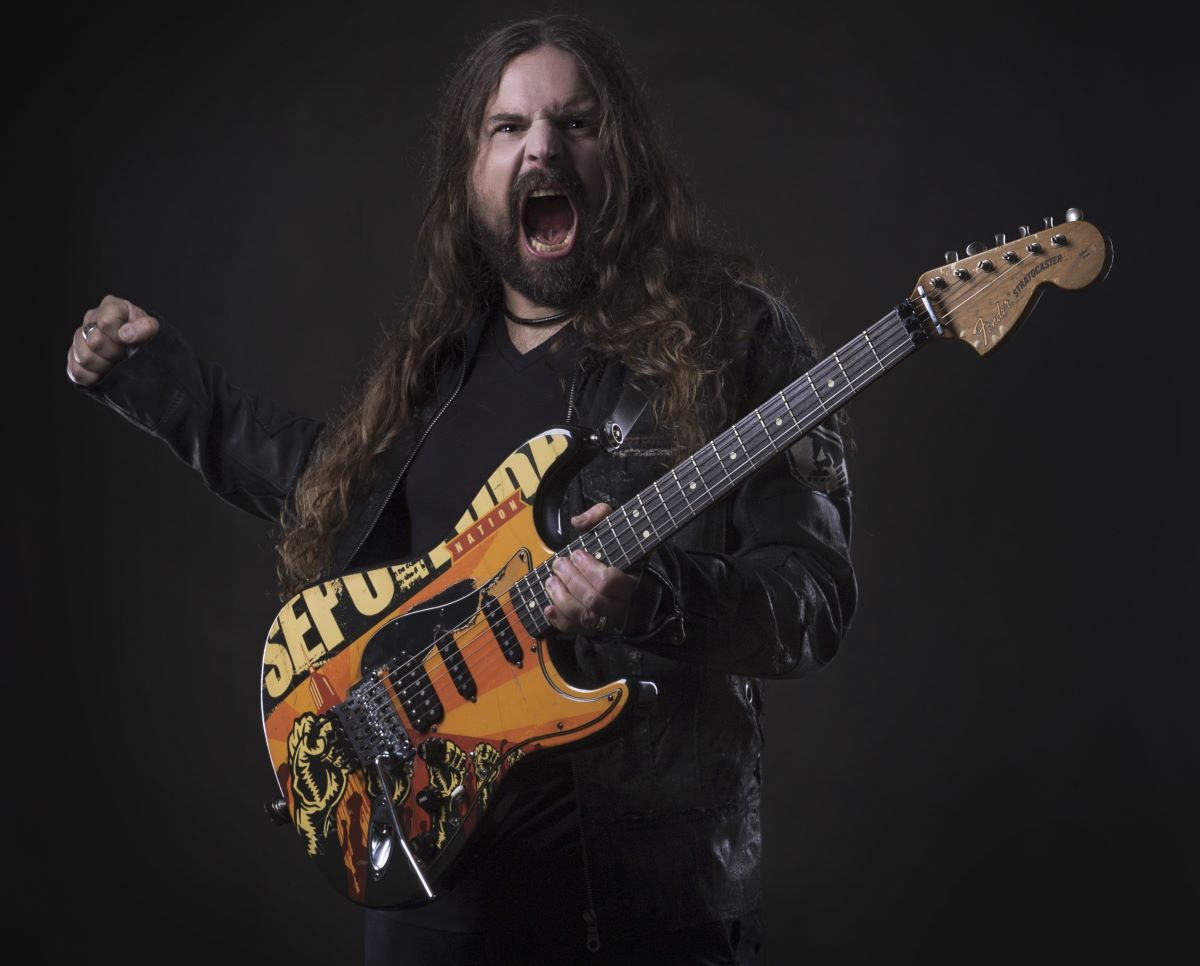
I still have many Strats that I use, especially in the studio. The special one that I have, which has the artwork of ‘Nation’ on it, is an amazing guitar. It’s a Mexican Strat, and it’s one of the best guitars that I have. I have used it on every album since ‘Nation’. Even Jens Bogren, who is a very picky producer with strings and sounds, encouraged me to use that guitar, because it felt so comfortable.
And that’s the point: you have to feel comfortable. The sound is not actually in the equipment or in the guitar: it’s in you. Of course it goes through those things, but you have to attack it, and you have to have a lack of respect for the instrument to make it work. If you put together the same equipment, have three different guitar players play through it, different sounds are going to come up.
I remember when we were opening for Ozzy Osbourne in 1992. On the first day, we were soundchecking, and Zakk Wylde came to the stage: if you guys need anything, here’s my tech, here’s my stuff, and we’re here to help you. Making us feel very welcome. It was amazing. Het let me try his guitar with his set-up, and it was shit for me, haha! Because it was set up for him to be comfortable.”
Expecting Nothing
“In Sepultura, I think I learned to play with every type of amp. Because in Brazil, we didn’t have Marshalls, we didn’t have Mesa Boogies, so we had to make do with the stuff we had. So we played with shitty Brazilian equipment, but that gave us the ability to work with anything. Or to expect nothing from the amp, and just go there and do it. That was our school.
We learned how to do it with challenges. We didn’t have the know-how, and we didn’t know what type of equipment we needed. I remember the first tour we did in Europe, trying to understand what the pedals did, what a rack unit was, and where the sound was coming from. It was crazy. But slowly, we learned, by working with great producers in the studio, and working with great companies, step by step, how to be comfortable and find our sound.
That’s why I guess I’m still pretty basic. Because there is no secret: I like EMG pick-ups, guitars with cable straight to the EVH, and work with the saturation there, the distortion in the amp. Everything else is a plus. I still remember when I first got my Boss pedal, the DS-1, that orange distortion pedal. It changed my life! I’m sure you remember the first time you played a distorted guitar. That’s why I’m here still, haha! It’s an addiction!”
An edited version of this interview appeared in Gitarist 404 (November 2024)
 Kevy Metal
Leave a comment