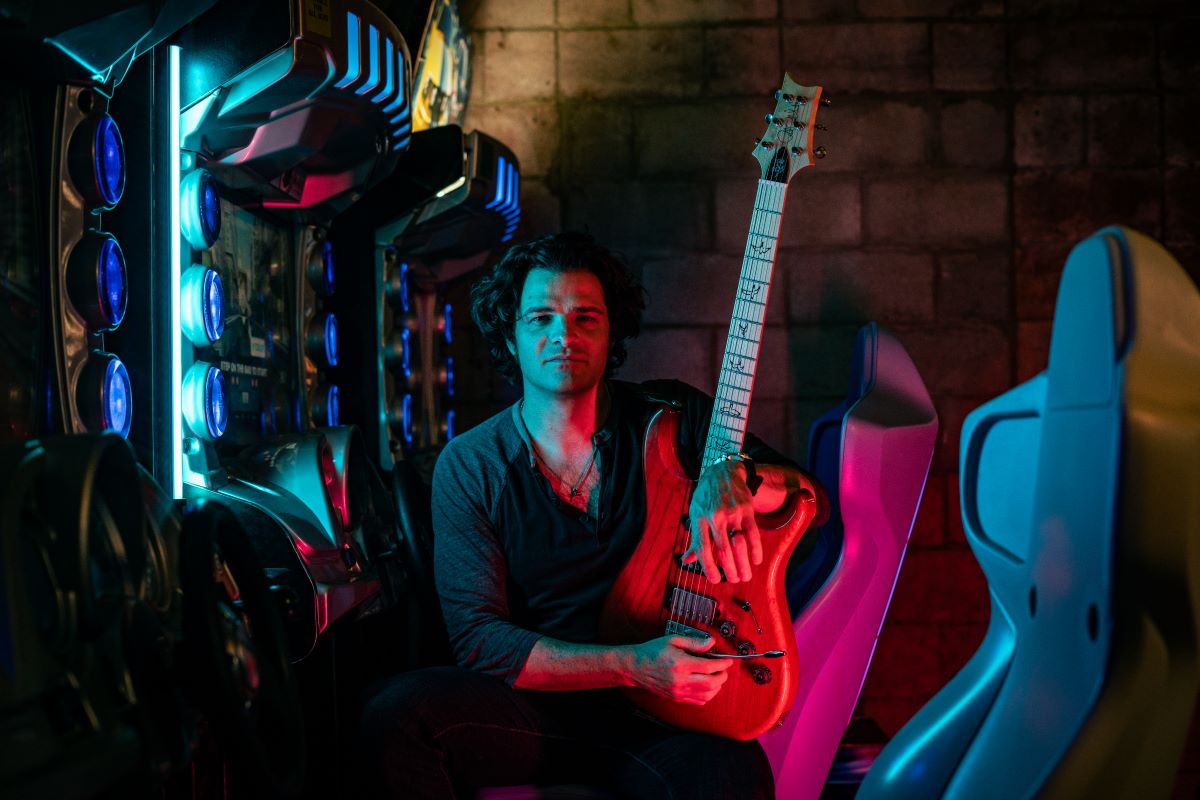
One of the goals of releasing his eighth solo album ‘Can I Tell You Something?’ was for Mark Lettieri to show that there is more to his playing than people realize. And so, apart from the funk and jazz grooves he is known for, there is a lot of eighties-inspired instrumental guitar rock on the album.
“I feel like ‘Can I Tell You Something?’ is one of my better melodic records”, Lettieri says. “I’m kind of known for my groove, and the rhythm side of my playing. Of course, I’m very grateful for people who think that’s cool, but I like to write melodies and hooks. And so I tried to be conscious of that maybe a little bit more this time around.
If you have only heard me from a ‘Baritone Sessions’ album, where it’s not a lot of melody, it’s mostly riffs, I can see where someone might be confused: ‘oh, this guy writes melodies too’, haha! So that’s what the title refers to. Like: hey, you know, I can do a lot of things.
I like to write lots of different kinds of instrumental guitar music. As long as it still feels like me and sounds like me, I’m still excited to create it. I don’t try to ever do anything that’s so unfamiliar to where I feel like I’m putting on someone else’s clothes or something like that. But I do feel like I have a pretty diverse sound.”
A Different Feel
“I compose all my demos here in my home studio, and they’re pretty thought-out. The parts I want to have played are written, the grooves and the arrangements are formulated. And then, depending on the kind of feel I want for the record, I might go into a studio with my rhythm section, and then just re-record everything live. Other times, I might have just the drummer and bass player to play over the demos, and then start replacing the guitars.
With ‘Can I Tell You Something?’, I did all the demos here, as usual, and then spent two days in the studio with Wes Stephenson and Jason Thomas doing bass and drums. They played to my original demos, and then I re-did all the guitars at home. Because I just want to try different tones, and the way they play together is going to change the way that I play and the sounds that I choose.
All the keyboards were done remotely by Daniel Porter and Bobby Sparks at their studios, and the violin was done by Zach Brock at his studio. That’s just a little more cost-effective. ‘Deep: The Baritone Sessions Vol. 2’ was recorded totally remotely, and I thought that record came out awesome. So I thought: maybe I can try that same process for a more standard Mark Lettieri album.
We did the drums and bass in two days, and then I just worked on guitars for the next two or three months. I had time to do it. I’ll probably keep doing it this way too. One of the things we like to do is to have the studio version of the song, then go in again and record a live version with the band, and film it for YouTube. Once we play the songs live, they feel different anyway. So it’s nice to have both things.”
Songs People Want to Listen to
While Lettieri and Snarky Puppy, the band he is most commonly associated with, are commonly seen as part of the jazz scene, it isn’t necessarily a moniker they are comfortable with. “Artists are almost classified by how the commercial aspect sort of deems them to be classified”, Lettieri says. “On Apple Music, there is no category for instrumental guitar-based rock music with a heavy funk, soul and jazz influence, haha! Which is what I do.
So they just put me under jazz-fusion. But when I think of fusion, I think of Weather Report, or Chick Corea. Which is beautiful music, but it doesn’t sound like me. But it is what it is. Nowadays, I think jazz just means that it doesn’t have words, haha! I guess if you want to qualify as jazz, you’ve got to have improvised parts, and you’ve got to have chords that sound fancy.
Hopefully everything I do is a songwriting record. I think I have a lot of chops, but I don’t have all the chops. So I know when to use that part of my skill set, so to speak, but really, I just want to write songs that people want to listen to. If I can live in both of those worlds, then great! And I think that’s fun for the audience too.
I like presenting music that has identifiable parts: a verse and a chorus, a bridge… But then has the potential to be completely turned inside out. The groove can change, the solos are different every night, the bass player is substituting changes… I like music that has the opportunity to fall apart if it wants to, but at its core has specific arrangements. If you’ve got a cool groove and a good melody, there’s nothing wrong with not having the words. It’s pop music with frills, basically, haha!”
A Point of Pride
Improvisational skills were something Lettieri worked on from a young age. “Always!”, he says resolutely. “As soon as I learned the minor pentatonic scale, I thought: okay, cool, now I can be a guitar player. I’ve always loved to improvise. I grew up improvising at jam sessions. As a teenager, if you could solo on the spot, you were the shit, you know? That was the thing: you can play a solo? Just like that? I’ve always liked being in situations like that.
Coming up as a professional guitar player in the local scene, you had to be able to get up there and play. When I was in college, it was a lot of Texas blues. And I’m a decent blues guitar player, but I’m not up there. But I could improvise. So I could play tunes, and play over the changes and all that.
Then when I got a little older, the jam sessions were more based on R&B, soul and gospel. I really owe a lot to the black gospel and R&B community here in Fort Worth and Dallas. That scene really turned me into the player and improviser that I am now. Because all those players can just play circles around everybody. And if you can’t hang, you will go home, haha! So I made it a point of pride to be able to hang.”
Playing in churches also did wonders for Lettieri and the other members of Snarky Puppy. “For sure”, Lettieri nods. “Plenty of players in that scene can sightread, but very rarely do you ever see a chart for anything. When we ere playing in churches, we would get a burned cd on like a Monday, and had to just know everything by the next weekend. And some of that gospel music is very complex. So early on, we were training our ears to really be able to master complex stuff without having to rely on paper.”
A Composer’s Dream
Snarky Puppy isn’t the type of band where you know which four or five musicians are going to be on stage at any given time. Depending on availability and what the music asks for, there may be up to three guitarists and various other instrumentalists. “It’s a composer’s dream”, Lettieri smiles. “Because they can get whatever they want; there may be seventeen or nineteen people, or however many there are on the session. It’s almost like option paralysis, haha! Like: I have all these keyboards, I don’t know what they’re supposed to do on this song!
In the guitar section, you will never be lost for a sound. We’ve got you covered. The three guitar players that occupy that chair are all very different. And I think I definitely bring that funk, the soul, and kind of that seventies, eighties rock style. Much to the chagrin of Michael (League, bassist and band leader), I don’t know if he appreciates it all the time, haha!
For Bob (Lanzetti) and Chris (McQueen), their rock is more indie style. And I love Larry Carlton and Eddie Van Halen. It’s just a little different. That’s also kind of the beauty of the guitar section in the band: that we’re all very different, and very complementary. We never really try to do what the others are more natural at. If there is a part of the song that sounds way better if Chris plays it, then obviously it will be delegated.”
Style and Language
Despite not considering himself a jazz musician, Lettieri is glad to have dabbled in jazz guitar lessons when he had the chance. “My ears were maybe wanting more of a challenge, or just something different”, he says. “I don’t consider myself a jazz guitar player in the traditional sense at all, but there are definitely parts of that style and that language in what I do.
It was probably in college when I started to gravitate towards that. I started taking some lessons with the jazz guitar teacher at my university. Not as a degree – I didn’t major in music – but I had some extra credit hours in which I took jazz guitar. That was pretty cool and pretty eye-opening, because I kind of learned jazz harmony and how to apply it to what I wanted to do.
That’s when I started learning about thirteenth chords, major seventh chords, flat ninth chords, and things like that. That’s when I thought: this is the sort of jazz sound I think I want to understand, but how can I bring it into what I’m doing? I became more open to it. There was a time in my life where I did kind of have to know some standards so that I could pull them out at jam sessions and things like that. It was something I wanted to dip my toes into, but not necessarily just dive all the way in.
All of my favorite players, even if they are classified more as a rock player or a funk player or something, they have all at least checked some jazz out, and immersed themselves into it to a degree that they absorbed something. Even if it didn’t completely change their sound. I think it’s worth it. Anyone who cares about improvised music has to give it a chance.”
This interview is part of Kevy Metal’s Gateway to Jazz series.
 Kevy Metal
Leave a comment