
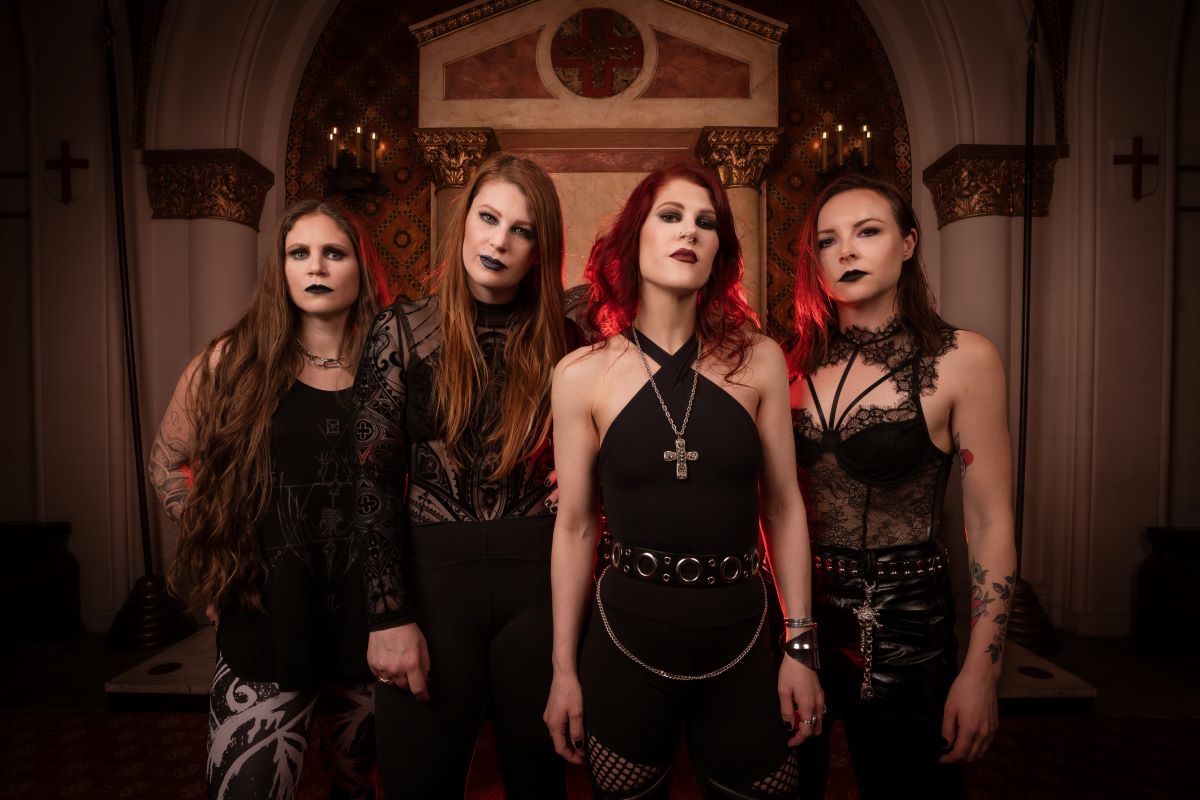
‘Fire’ is the first Kittie album in nearly thirteen years. While the break has done the Canadian quartet well – the band sounds reinvigorated on the album – it was not always a given that there would even be a new Kittie album. Lead guitarist Tara McLeod tells us more.
After the death of former bassist Trish Doan at the far too young age of 31, as well as a successful run of concerts in 2017, singer/guitarist Morgan Lander was fairly certain there wasn’t going to be any new Kittie music. “It’s kind of hard to say”, McLeod says, trying to recall when the ball started rolling. “It’s kind of like new music happens to us, if that makes any sense. That handful of shows we did a couple of years ago, that was really like a victory lap, and we had no plans whatsoever.
We were all on the same page as Morgan: that was good, we’re not going to close the door, because we are still so tied to this band, and we don’t want to make the end of it official. But we were pretty certain that was it. It was just hard to say. So we didn’t, haha! But then one thing just kind of lead to another, and we didn’t actually intend to do it.”
Ten Years Rested
Then there were some festival shows in 2022: “We saw Ash (Avildsen) from Sumerian Records, who used to book Kittie way back in the day at one of his festivals. And he said: you guys really have something going, I would love to be involved with this and get you to play new music again. That’s when the conversation first started again. All of us thought: okay, I think there’s some more, let’s see what we can do. We’re all ten years rested, haha!
‘Vultures’ was the song we started playing first, and it actually did end up on the album. Which is actually really nice, because there was a lot more than ten songs that we wrote. It just happened to make the final cut. When that song was done, we decided to play it live, and it was just so well-embraced that we thought: alright, we’ve got a thing going here. I guess we’ve got to get this stuff together.
So we signed to Sumerian, we started reaching out to producers, and everything just seemed to keep flowing. We just had to jump on the train and let it go.”
Intimately Familiar
In the past, McLeod has been enthusiastic about being taken seriously as a contributor to Kittie’s music. That has not changed. “It was just that we had a bit of a different approach this time”, she explains. “Previously, when we were creating ‘In the Black’ (2009) and ‘I’ve Failed You’ (2011), we lived twenty minutes from each other. Nowadays, we live across the country from each other. So that’s a bit more complicated. It takes me a flight to get to them.
Luckily, with the progression of home studios, we did everything in Logic and GarageBand, and we could swap riffs that way. Morgan and I are so connected as guitar players that we kind of just jive like this without even trying. Which is really cool, because we are both intimately familiar with each other’s playing styles and riff writing styles. So there was a lot of: hey, I popped a couple extra things in the Dropbox, what do you think? And there would be some adjustments made, and we were kind of building together.
For a majority of those songs, going into the studio for pre-production was actually the first time we played most of the songs together. It was actually quite a reaffirming experience to get into the room with those four and know: that’s the drummer I need to play with, that’s the bass player I need to play with, that’s the other guitar player I need to play with. It all came together. It’s maybe a bit tacky to say, a cliché, but it honestly felt like magic. Like: oh yeah, that’s what we need to do.
Our producer said: wow, you guys are really synced up! But we used to practice together every single day. It was how we thought every other band was operating. We just thought that that’s what you did. I would be in Morgan and Mercedes’ (Lander, drummer) mom’s basement with them every single day. Practicing.”
Two Pairs of Hands Playing Guitar
“We have a very old school approach. We don’t have any tracks, and Mercedes doesn’t even play to a click to keep her on. There’s obviously some layering and studio magic that happens when we are recording, but we have been pretty adamant that the songs can’t sound completely different while we are playing them on stage. Because for us, that would be a disservice to the music.”
That also means that McLeod plays rhythm guitar in addition to lead guitar on ‘Fire’. “I wasn’t really sure how we would do this”, she admits. “Every producer is a little different. We have always done it this way, but to my recollection, Morgan has carried the rhythm guitar parts just a little bit more than me.
For this one, Nick (Raskulinecz, producer) was very adamant that there should be two pairs of hands playing the guitars. He was also very adamant that they had to sound like the same pair of hands, but they can’t be the same hands. It’s nice though, because Morgan and I work so well together. There would be a couple of times where we would sit down and figure out the rhythm parts together. She’s my favorite guitar player to play with.”
Dream List
Throughout the conversation, McLeod repeatedly is highly positive about Nick Raskulinecz and what he has brought to ‘Fire’. “He’s just a dream to work with”, McLeod says. “We really lucked out. Nick was our ‘the worst thing he could say is no producer’. Because we had a dream list, and Sumerian said: it doesn’t matter, anyone you would like to work with, put them on. Ivy (Vujic, bassist) was actually the one who said: what about this guy?
We looked at his resume and we thought: no way he’s going to work with us, haha! But he said: sure, send me your demos. So we did, and we had a meeting with him. And he’s just so passionate about music. When we had that meeting, he could talk about riffs by name, like by song. He really, really listened. He didn’t just turn it on and say: okay, whatever, I can work with that.
The way he was referencing parts of the songs made us think: this is our guy! And then we got into the studio, he took one of Mercedes’ drum sticks, and he’s conducting with it. He’s showing her how to hit her kick at some points, and pointing at us, going: now you stop, now you go… He was so dynamic that we knew: this guy gets us.
Like I said, we are quite old school, but we know that we needed a new sound. Because of that, we were kind of concerned that we would be pushed into things like drum programming. Which works for a lot of bands, it just doesn’t work for us, because we have a drummer who has so much feel. It wouldn’t be right for us. But that wasn’t Nick at all. He totally understood us. He made us sound old school, but also up-to-date. We’ve had a wonderful experience with him.”
Neil Peart’s Drum Set
“Nick bringing out Mercedes’ feel was one of the refreshing things as well. I don’t think she’s been captured to the best of her ability before. And I think on this one, he got it. He got the push and pull of her feel. There was no straightening out of beats. He was very hands-on. He was kind of Mercedes’ drum tech, as he was changing her heads and tuning her drums. His hands are on everything.
He worked with Rush as well, and so he had been gifted one of Neil Peart’s drum sets. Mercedes recorded the majority of the drum parts on the album with Neil’s drums. We needed her kick, because the one on Neil’s kit was too big; she needed a smaller kick. But it was really cool. Obviously, we’re Canadians as well, from the same province, so we all thought: this is really awesome! This American guy is bringing us to Rush, haha!
Also, he just casually mentioned it. We asked him: for real? And he just calmly said: oh yeah, it’s just in with the rest of my stuff. We said: okay, shouldn’t you protect that drum kit? Haha! There’s a lot of albums on his resume that I’m a huge fan of. It’s awesome as a fan to hear how that sound is connected to ours. How it sort of overlaps in his world, you know what I mean? It’s really cool to think: this guy did Alice In Chains, and I can hear a connection here.”
Appreciating an Outside Ear
A drum kit from his recordings with Rush wasn’t the only bit of gear Raskulinecz brought to the ‘Fire’ recording sessions. “All the amplifiers were his gear”, McLeod explains. “He had everything shipped to the studio we went to. I think most of what I played was through an old 5150 head. He had some really nice gear. He had this oversized Marshall 4×12″ cab from 1973 as well, and we played through that for a lot. I used a plug-in here and there for some of the overdubs, but the majority of it is all real tones.
Nick also has a white Les Paul that both Morgan and I played so much on the record. A lot of the guitars on the album is that white Les Paul, my own Les Paul Goldtop, and I also brought an ESP along to the sessions. I played that a lot, because it’s got EMG’s in it. I do have the original PAF pick-ups still in my Goldtop, so it’s a bit thicker and darker.
It’s always nice for Morgan and I to have such different pick-ups, because we’re still playing heavy, but it sounds nice and different and complementary to each other. But I did want to have the opportunity to use some EMG’s on the record too. To get a little more bite out of it.
My favorite preface for my lead guitar parts is to be able to actually bounce things off the producer. I don’t think I’m better than anyone, I don’t have an attitude about it, I really appreciate an outside ear. So I worked through a couple of things with Nick, just to figure out what is right.
There were things like ‘Wound’ that I worked out quite a bit before, and I think I sort of solidified what I was going to do on ‘Eyes Wide Open’ the night before. Sometimes they come to me really quickly, sometimes I have to dig them out a little further, haha!”
Embracing Digital Units
Old school as Kittie’s approach is, their live set-up as been significantly modernized. “Both Morgan and I have done a full overhaul”, McLeod says. “We have embraced digital units. So I use a Neural DSP Quad Cortex, and she is on a Line6 Helix unit right now. It’s been a bit of a luxury, because so far, all of our gigs have been fly-in dates, and it’s really nice to have the exact same sound and tone regardless of where we go, even if we can’t bring our original heads with us. And also, it has to do with the fact that we’re now in our forties, and our backs are not youthful anymore, haha!
I love real amps, and I was a little stubborn about it, because I also love my stompboxes. That’s why it took me so long to change. But the moment I changed, I just kept getting all these compliments on my sound. I was on a gig with a different band the other day, and one guy was being a little snobby: oh yeah, I can’t find any of those things that I like. I said: that’s cool, that works for you, this works for me, I’m not offended, haha! And by the end of the session, he said: that is a really good tone. Yes, it is, haha! I think it has changed some minds.
I totally get it too, because I did try a couple of the first modelers out when they first started coming out, and it just didn’t do it for me, so I abandoned it pretty quickly. But yeah, technology has come around, and so have I, haha! I’m also using the effects in the Quad Cortex. They’ve done such a good job. I’m a very big fan.”
Peace of Mind
Aside from Kittie, McLeod is active in other musical projects in various genres. “That is part of the luxury in having the Quad Cortex”, she says. “Because I am playing so many different genres of music that I would have to have had a whole studio full of gear, and many different amps to cover all the tones. Right now, it’s just really nice to be able to go: okay, this is what I play when I play shoegaze, pop that in. This is a Canadian rock band, there you go. Metal: boom, there you go. It made everything a lot easier.
Also, it’s just peace of mind. Because you never know if you’re flying into something what kind of amp you’re going to get. You can ask for the model, but it might be a complete shit version of the model, or it might be broken, and you just kind of have to accept that that’s the amp you’re going to get for that day.
And you know, as much as I love stompboxes, you put them in the case, and you try to get them in there as tight as possible, but all the little knobs turn. Then, when you go to play again, you have to re-dial everything in all over again. My selling point for the Quad Cortex for everybody is that I don’t have to go shake cables between every single pedal anymore. I just go: oh look, it works! It’s crazy, haha! Man, I don’t miss that, haha!”
Heavy as Fuck, Tough as Nails
One of the most pleasant surprises on ‘Fire’ was the progress that Morgan Lander has made in the vocal department. McLeod was not surprised. “Morgan has sung in a couple of projects of which, unfortunately, the music hasn’t been released”, she explains. “But we’re pals, so she sent me the recordings as they were recording them. So I’m not surprised at all. She really upped her game. She worked really hard. I’ve been able to take a back seat and watch her vocal progression.
Her scream is sounding deadly. Her melody writing has become insanely good. She has always been really gifted that way, but she worked really hard on it and adjusted as she went. ‘Fire’ is by far my favorite vocal performance on a Kittie album. Well… It’s my favorite Kittie everything, but the vocal performance is just incredible. I’m actually really pleased, because I see a lot of people commenting about it as well. So yes, give her a pat on the back, because she worked really hard for that!”
McLeod also seems pleased that the musical maturation did not go at the expense of any heaviness. “We were very clear about that by releasing ‘Eyes Wide Open’ first”, she says. “To be able to say: this is the band we are. We are heavy as fuck, and tough as nails. This is how we would like to be reintroduced, so that people remember: this is a fucking hard band.”
Testing the Waters
In the period leading up to the release of ‘Fire’, it has been announced that touring activities to promote the album will be limited for the time being, due to other commitments in the band members’ lives. “We’re trying to do as much as we can”, McLeod says. “It’s an interesting thing. Because we are a band with a long history, but the music industry has changed so much lately. Not only the gear that we’re talking about, but the industry as a whole.
So it feels like the past year or two, we have not only been recreating the band and figuring out how to do this, but we’re actually getting to know the music industry again, in a way. Which is kind of funny, but we’re having to start from scratch again. We’re testing the waters with these headlining shows that we’re doing throughout July and August. We’re just going to see how this goes.
We didn’t want to go in way over our heads either. We were road dogs. And that was exhausting. We definitely ground ourselves down into the ground and really burned ourselves out. And another thing was that we wanted to be able to be fresh, so that every show is the best live show we can possibly play. So we’re just easing into it.”
 Kevy Metal
Leave a comment