
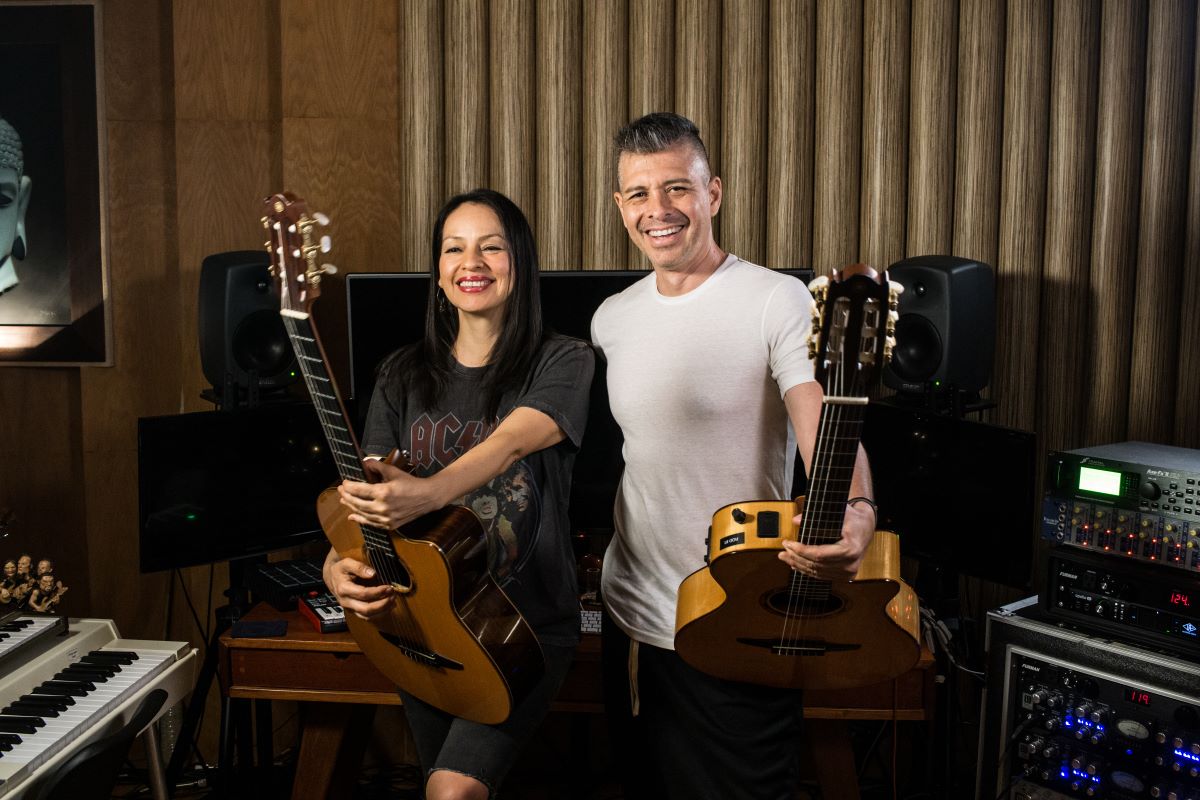
Since around the turn of the century, Rodrigo y Gabriela have been expanding the boundaries of acoustic guitar music. Lately, the guitars they use don’t even need to be acoustic anymore. Rodrigo Sánchez and Gabriela Quintero explain how their music has developed over the past few years.
“When we started out 25 years ago, we couldn’t really find many acoustic guitar duos. Now there are plenty; acoustic bands and instrumental guitar duos playing a little bit of rock. Now we feel like going the opposite way, because that is what we always do”, Sánchez laughs. “We learned a while ago that we don’t have to stick to any style or any rules. Gab and I love electric guitars. We love electronic sounds as well.
Ninety percent of what I play on ‘In Between Thoughts… A New World’ is played on an electric guitar. When we recorded the music, I tried to play the same melodies on acoustic guitars, but they just sounded better on electric guitars. We felt the music needed that kind of sound.”
Quintero’s parts on ‘In Between Thoughts… A New World’ were actually written on both acoustic and electric guitars. “I was hoping to play something different on the album”, she admits. “Different arrangements, or maybe some bass lines or maybe some things with a pick, and change some things a little bit. But in the end, Rod said: no, the way you play is what gives the drive and the beat. He convinced me to record the whole thing with my style of playing.
Nevertheless, it was fun to do. At the moment, we both are very happy with the results. Maybe, one day in the not-so-distant future, I can go back to the electric guitar, because now it is kind of calling me, haha!”
Tropical Apocalypse
It was not just the boundless urge to experiment that made the ‘In Between Thoughts… A New World’ sound so different than the earlier works of the Mexican duo. “When we were recording the music, we weren’t aware that we were actually recording our new album”, Sánchez explains. “It was during the pandemic years, so there were no limitations to what we could do. We were just creating music, and using the elements that we had in the studio. That’s why we added a lot of synths, electronics, even the orchestra.”
“We had no idea this was going to be the new album”, Quintero confirms. “Because we thought: this is the apocalypse. And even though we were in Mexico, in a tropical paradise, we though it was a tropical version of the apocalypse, haha! We didn’t know. We were writing and recording this music as a way of just killing time, and see if the world was going to continue.
Because we never thought this was going to be the new album, we just let ourselves be free, creatively speaking. Instead of thinking: we are an acoustic duo, we are not supposed to do an album with electronics. We didn’t even think about that. We were just trying to create a certain momentum, then just experimenting more and more. And that’s how this album came to be.”
Titanic
The recordings of ‘In Between Thoughts… A New World’ also came on the heels of the duo winning a Grammy for their 2019 album ‘Mettavolution’ in the Best Contemporary Instrumental Album category. “Having won a Grammy just a few months earlier would probably have made us overconscious of writing a new album”, Sánchez says. “Just the pressure of having to follow that up. That kind of went out the window. No Grammy, nothing really matters. We’ll have to see if the world goes back to normal or not, but in the meantime, we just continue playing. Gab has said this in other interviews: we did it like the musicians on the Titanic.”
“Those musicians on the Titanic, they just kept playing as the ship was going down. So for us, that was a sign that made us think: okay, I think that’s what we have to do”, Quintero smiles.
“And we didn’t have any expectations because of that”, Sánchez continues. “So we forgot about the Grammy, about the follow-up, and all that shit. We just started writing music, and I’m glad we did. It is for sure a more spontaneous album because of that.”
Drunk Aliens
Traditionally, Rodrigo y Gabriela are associated with their signature guitars from the Yamaha NX series. “We still both play our Yamahas”, Sánchez acknowledges. “But like I said before, ninety percent of the album is electric. Most of it is played on a Fender Jaguar. But for a couple of songs, I used my Les Paul, like on ‘Broken Rage’.
We are in the middle of a tour that will take two years, and the first year, we will be playing with backing tracks. For the second year, which is cooking as we speak, we will be touring different venues with a full orchestra. It is a massive logistic situation. I use Fractals these days. All the different sounds that I have in every song that are a clear and important part of each song, to be able to synchronize that… That definitely makes the life of my guitar tech a lot easier, haha!”
Although Quintero sticks to her acoustic guitars, she has been experimenting with her sound: “I’m always experimenting. For this tour, I wanted to bring my wah pedal, and a delay pedal. It sounds a little like drunk aliens, haha! Like in my solo spot, it’s really cool and I really like it.
I think I will use more effects in the future, because I really like them. It’s fun, but it also adds to the concept of the album. And probably for what’s coming up next as well. That is another consequence of imposing as few rules as possible upon ourselves.”
Doing Our Own Score
What may help Rodrigo y Gabriela’s albums to maintain their listeners’ attention so well is the narrative thread running through them. “Storytelling is important to us”, Quintero nods. “Every album has a narrative or some sort of story. ‘9 Dead Alive’, for instance, has the story of these nine great works of humanity. For ‘Mettavolution’, we created a world in our heads, or a completely different planed, based on great technology that serves life rather than destroy it.
For ‘In Between Thoughts… A New World’, there is a more definitive story, that at some point we will share with our fans. with characters and pieces that are linked to each other through the story. For us, it was almost like doing our own score to the story. We hope we are able to tell that narrative, and people can come up with their own ideas and their own stories as well.”
Telling their stories without words comes easy. “Music is another form of communication that is older than any actual language”, says Quintero. “Emotions existed long before language. Music has always been a good communicator for expressing them. The intention that you play the music with as well. In that way, we don’t limit ourselves. That’s also the beauty of cinema; it’s never as good without the music.
Maybe next year, we would like to release the story, maybe as a comic, so people will kind of know what’s happening on this album. We want hem to have the full picture. And we will do that at some point, but for the moment, everything is okay as it is right now.”
Massive
An interesting aspect of the music of Rodrigo y Gabriela is the way the parts are divided among the two guitarists. “Both of us come from a metal band”, Rodrigo explains. “When we moved out of Mexico City and we left the band, we were used to having this band sound. At the beginning, we were playing covers on the streets in Dublin. And Gab is a great pick player as well, and we were trading solos and melodies.
But then she started working on developing this unique technique that some people in the beginning kind of confused with flamenco. We love flamenco, but it has nothing to do with it. She developed this technique in order to keep the beat going. We used to play in a pub in Ireland, where I was our own sound engineer, and I developed that sound as well. We didn’t have the Yamaha guitars yet, but whatever guitar we had at the time, I wanted to have this massive pump.
So we developed that sound out of necessity. Being used to this rock ‘n’ roll sound, she took the role of the bass player and the drummer, and I took the role of the guitar player and the vocals by playing the solos and the melodies.”
“The sound is super important”, Quintero emphasizes. “Our sound guys know already: the sound of my guitar is like the drums, so it should be supermassive. As metalheads, we like the drums to be really loud, haha! That has always stayed the same.”
New Patterns and Rhythms
“The guitar is such a universal instrument”, Quintero says. “There are so many genres of music that the guitar enables to exist. From bossa nova to classical guitar to Pantera: for us, when we were very young, we were attracted to guitar music. Because we didn’t study music, our formation was more a rock ‘n’ roll sort of thing. And we loved all these different genres.
Our background in metal shone through the music. Even in the very beginning, before we came to Europe, when we were playing covers at hotels in Ixtapa around sunset. We would play acoustic arrangements of metal ballads, like ‘Welcome Home (Sanitarium)’, ‘Fade to Black’ and ‘One’. People would ask us: what’s this romantic music? We would say: oh, this is Mexican contemporary music, haha!
When we went to Europe, we saw Paco de Lucía play with a sextet. That was amazing. But we didn’t know how to do that, all the jazz stuff and everything. I guess we stuck to what we could actually do. Everything we play had this rock feel to it, even though I tried to copy the flamenco style, and never got it right. Nowadays, you can go to YouTube, search for ‘how to play rumba’, and you get videos and tutorials. Not back in the day.
So I was trying to figure it out, and I always got it wrong, but I found new patterns and new rhythms. In Ireland, we were playing with some Irish musicians, and they played bodhrán, which is an Irish drum, and I learned a couple of those patterns, and integrated those into the rhythms. And it has developed spontaneously into this.
Nowadays, there are a lot of acoustic acts that are not particularly classical or pure jazz. Now they’re into alternative rock and different styles. It has changed a lot. Which is great, because it brings more diversity. We might not be as unique as we used to be back in the day, but that makes it all the more interesting to get out of our comfort zone.”
Challenging Fans
“We already writing the new album”, Sánchez says. “It’s already going in a more interesting direction. We are using some electronics again, but the songwriting is different. It is much more complex: ten-minute songs, and we’re loving it. We’re playing a couple on the set. And the label hates it, haha!
At the end of the day, they kind of belong to the new sound of what we are trying to achieve now. We’ve been playing the full new album, which is different to what people are used to, and then we’re playing these three new songs, which are totally different in terms of structure and composition.”
“At this point in our career, we don’t care about being nice to the industry and asking them what we have to do”, Quintero adds. “We are going to do what really drives us. Once we found that, we asked ourselves: what would we be doing if we weren’t musicians? We would still be making music, because it’s the only thing we can do. Don’t get me wrong, we love our label.”
“And they respect us”, Sánchez nods. “They came down to the first few shows and said they couldn’t believe that we were doing those new songs. My mother said the same: you are challenging your fans too much. But our fans are intelligent people. They like that. We don’t want to keep playing acoustic music simply because that’s what people know us for.”
Inspire Your Team
“I think it’s important for young artists – and artists in general – to understand the universal idea that you are the one who is going to inspire your management or your team”, Quintero says. “With your idea, your creativity. Not the other way around.
If it happens the other way around, you are dealing with people whose job is to make sure that everything you do creatively fits in a box. But taking risks is a good thing. If you always stay in your comfort zone, you will never get better. It doesn’t matter if you’re scared or nervous, as long as you do it.”
Rodrigo y Gabriela will be touring Europe from June to early August, and the United States throughout September. Tour dates can be found on their official website.
An edited version of this interview appeared in Gitarist 391 (October 2023)
 Kevy Metal
Leave a comment