

Psychomanteum Records is the new label run by Christopher Morris, or more specifically a rebranding of his old label Setsuzoku Records, with a focus on international hard rock and heavy metal rather than Japanese music. Morris explains the necessity of the rebranding in light of frustrations with Japanese scenes.
“I have run into so many music industry professionals who have asked me: what are you doing wasting your time with Japan? The Japanese are so siloed in their thinking. The music business and the artists work differently there. Artists may not have the same motivations for making music.
I have found many Japanese artists lack artistic integrity. Some have it of course, but they are not more famous for a reason. It’s because they are not finding the support in their own system and they can’t just get it from overseas fans willing it into existence. An artist might have vision and integrity, but they don’t necessarily know what to do with it.
Japan is very much like The Matrix. My job since starting my company has been to unplug artists from The Matrix, have them wake up in their pods and realize there is an entire world out there where you can make an impact. My little ship, my Setsuzoku version of the Nebuchadnezzar, is doing its best, but they have to want to be unplugged.
That scene where the guy says: I’m going to make a deal, plug me back in… That happened so often. And in some cases I can even understand it. Especially with idols and some of the girl groups: it’s not their fault that they have been farmed. It’s just the context they’ve been brought up in. And when my entire business model is based on unplugging them from The Matrix, it’s a challenge. They get scared and want to be plugged back in.”
Over the Edge
“Unfortunately, there is a feeling in the Japanese music business where artists just want to have an international experience rather than become international artists. They just want to get a paid vacation or an experience that will make them look good on Instagram. That’s not something I can accept at my own expense.
One’s belief in an artist has to have its limits when you see the threshold of what they can do. Or in some cases when you take them even further than expected, but they don’t appreciate it. In one case, when I even fly to LA to sit down with Capitol Records and the artist just shrugs their shoulders. ‘I’ve kind of changed my mind’. That’s intolerable. That was one thing that pushed me over the edge to make the branding change.”
Association
“There is something so strange about the association of Japanese music with other aspects of Japanese culture. There is this assumption – and there is a community that backs up this assumption – that if you are interested in Japanese music, you must also be interested in other aspects of that country’s popular culture. Or the country’s general culture and language.
I don’t like anime or play video games. There’s nothing wrong with it if you do, but why should the musical output of a Japanese artist who doesn’t even do anime or game soundtracks have any association or connection to that? And then it needs to be mentioned, it needs to be in interviews, it needs to be represented at a convention somewhere… I don’t get it. You can love Japanese music without being associated with other aspects of Japanese culture.
I cannot think of any other country or region that really has that kind of association. If you like Sabaton or Arch Enemy, people don’t just assume that you only buy furniture at Ikea and spend all your free time watching Ingmar Bergman movies. So why is it that way for Japan?
That is something I really needed to pull away from. I felt it first when I was working at Hyper Japan, a convention in London. I had fallen into this culture of: well, it’s Japanese, therefore I must be there. It took me a couple of years to realize this was going against my better judgement. And that happens in business; sometimes you just follow a path you’re on and before you know it, you’re lost.”
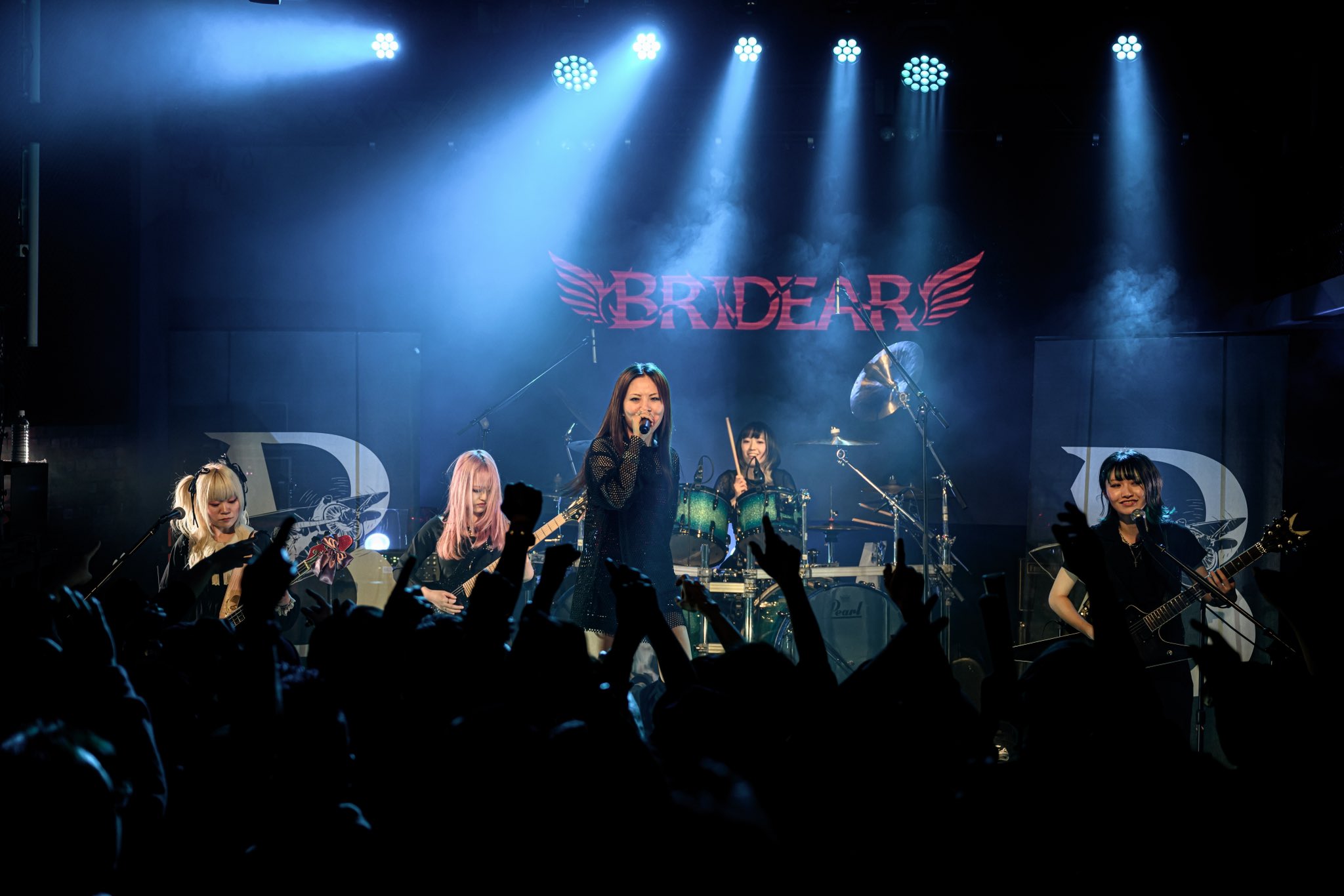
(photo credit: Bridear)
Objectified
“The last Bridear tour, I was with them in Düsseldorf. One of the coolest moments of the VIP meet and greet before the show was a dad who had brought his daughter. She wanted her picture taken with Bridear. I will never forget that, because that is one of the key moments in my work where I realized that I was doing the right thing. Any Japanese all-female group should be inspiring women anywhere.
When I contrast that with a moment like having an angry outburst at Hyper Japan because some idol fan is getting pissed off at a time limit for getting a cheki, one makes me feel like I’m doing good work for good people – and doing it for the right reasons – while the other makes me realize that I’m participating in the problem. That tension needs to be resolved. And the branding change is part of that.”
Another point of contention for Morris is the way female Japanese artists are presented: “Their fans are middle-aged men objectifying them, because they are being presented in an objectified manner. I’m happy they have fans supporting them, but the way that they are promoted and the way the Japanese music industry handles women in hard rock and metal targets that fanbase. They are not young metalheads. There are no women coming to these shows.
It’s really offensive. That young girl who came to the show in Germany with her dad, why isn’t that happening in Japan? It’s because of the way artists are manufactured, presented and sold. And I’m deeply, deeply disturbed by that. It’s one of the reasons why I really respect Mari Hamada. She doesn’t go out there and present herself in an objectified manner.”
Primary Passion
Speaking of Mari Hamada; she is one of the few artists that will join Morris to Psychomanteum Records. “I’m taking Bridear, Exist Trace and Mari Hamada with me”, he explains. “And possibly Ibuki. She was the first artist on Setsuzoku Records. We’ve done three licensing deals for three albums and a little bit of merchandise with Ibuki. She was also a participant in Metal Matsuri in 2019. Her commitment to that even took her away from her daughter during her daughter’s birthday. I have never forgotten that. If there is something I can do for Ibuki, I will do it.
I have had to say goodbye to others, some of whom were more frustrating and others that I think were well-meaning, but didn’t fit the profile anymore. Then there is the change in genre focus. I dropped all idol, I dropped all pop, I have no interest in working with anyone outside of hard rock and heavy metal. It’s not only my bread and butter, it’s my primary passion. It’s not just a branding change; it’s a philosophy change. It’s getting realigned with why I started this business to begin with.
It seems that there are more interested international parties in hard rock and heavy metal than there are in pop music. For example: it’s much easier to have a heavy metal band taken seriously by Metal Hammer than it is to have a pop group taken seriously by Spin or Rolling Stone. Pop music is also associated more with the aspects of Japanese pop culture output that I wanted to avoid.”
Fresh
“The first Psychomanteum release outside of the Japanese landscape, which will be released in early 2024, is a Polish black metal artist. I had a friend who was playing in an underground unsigned death metal group, but it was clear that the members were likely going in different directions. I said: well, I happen to be looking for artists outside of Japan and if I can help you build this, I’m more than happy to help.
There is what looks to be an eight or nine track album. I can’t say the artist right now, because it is so brand new that he is deciding whether or not he wants to promote it as a full band or a one-man project. Those decisions are still being made. It’s really exciting to be part of a project with a legitimately brand-new, fresh artist doing something that is close to black metal’s roots. It’s kind of like early Satyricon, it’s got a bit of that early Darkthrone vibe and it’s a bit lo-fi. I will probably reveal more details in January.
There are isolated scenes with artists who deserve more attention. That’s why I started Setsuzoku Records: as a means of connecting Japanese artists to a broader international world of music. Which is what Setsuzoku means: connection. I would love to do that for other isolated scenes. Japan maintains its isolation, but has built its own massive industrial complex. And that creates major roadblocks. Because then what you have is a major music scene with built-in restrictions and built-in ignorance that prevents it from doing productive business elsewhere. That is always to the detriment of the artist, but they don’t know that it’s to their detriment.
There’s a difference between being stuck in an isolated scene and kind of having a DIY mentality of going out there and playing music because you love it, yet not knowing how to connect to another audience, and an isolated scene that goes: this is the way we do things and yes, we can go abroad, but we have to do things our way. It’s a very different dynamic.”
Tick the Box
“I had a conversation with a booking agent involving a number of European festivals. One of my artists was turned down for a spot. I’m very used to that; hundreds of bands get turned down every year. It’s tough to get a spot. This person said to me: we already have a Japanese group. And I think: okay, so you’re looking at them as a token presence, to basically tick the box that says ‘diversity’.
The artist he was referring to was female, as was the artist I was pitching. But elsewhere on that festival line-up was a male Japanese group. It didn’t even occur to this person that the other group was Japanese. So what do I have to do to get my artists thought of as just a great band, where you’re not even thinking where they’re from?
This clinging that Japanese artists do to their Japanese pop culture identity makes overseas agents, media, label people, whoever think in whatever narrow terms the artist is presenting themselves. So if an artist presents themselves as an international artist that isn’t overly connected to their Japanese-ness, maybe overseas agents and business people will go along with that.
In the future, I’m hoping to build a roster that eliminates my reputation for working with the Japanese. I’m not even saying that as a means to diminish my work with Japanese artists; I’m saying that because it also benefits the Japanese artists I’m working with if they are on a roster with artists from all over the world that doesn’t isolate them based on their ethnicity.”
Underserviced Scenes
“At the moment, I’m taking things very slowly, because I just had the unpleasant experience of having to drop quite a few artists. And I need to decide how resources are going to be distributed, what the focus will be for the Japanese artists I am keeping, and just how many artists I’m looking to sign. That’s still up in the air. I would love to get about three or four non-Asian artists on the roster. So I am actively on the lookout for deserving artists from any scene, but particularly from underserviced scenes.
I have wanted to connect Japanese artists to a broader world, but my business was Japanese exclusively. There is a conflict there. But the only way I felt at the time that I could make these artists known was by focusing on that and highlighting what was happening in Japan. A couple of years down the road, I now feel it’s working against my artists. They will be better off if they are associated with international artists. I can be a champion for a better cause if that is the case.”
 Kevy Metal
Leave a comment