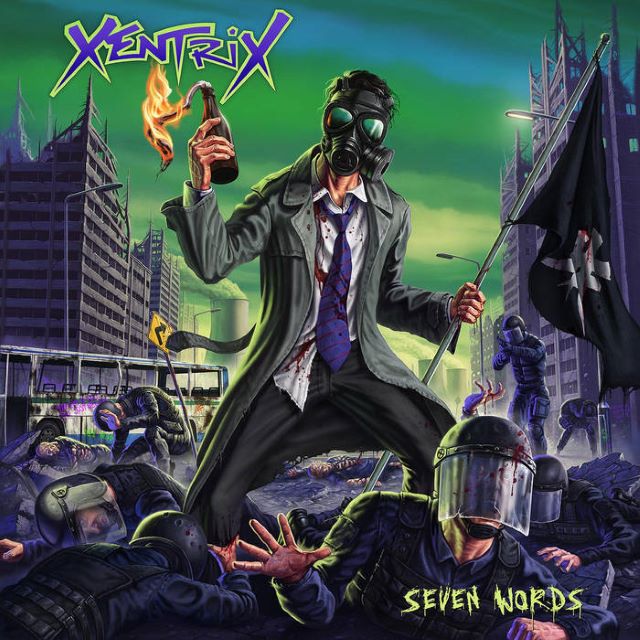
Not many thrash metal bands from the eighties can claim they release their best work in the twenty-first century. Plenty of them released “best since” albums, which often lack what made the bands in question special in their heyday. Xentrix appears to be one of the exceptions to that rule. After the solid, but unspectacular 2019 comeback album ‘Bury The Pain’, ‘Seven Words’ is actually every bit as good as their 1990 semi-classic ‘For Whose Advantage?’. Somehow, Xentrix’ fairly traditional thrash metal sound manages to translate to this century very well without needing modern shenaningans like extreme metal leanings or predictable breakdowns.
What might be the biggest advantage of ‘Seven Words’ is that Xentrix sounds like themselves again. ‘Bury The Pain’ felt like it was trying to be contemporary Exodus or modern Onslaught at times. This time, only Andy Sneap’s production job gives away that more than three decades have passed since the first two albums. For those unfamiliar with Xentrix: imagine a more intelligent Testament of maybe Metallica’s recent work with better self-editing skills and a much tighter drummer. Current frontman Jay Walsh has a voice that is remarkably similar to that of his predecessor Chris Astley, but it’s the songwriting that makes ‘Seven Words’ comparable to Xentrix’ early work.
Mid-tempo is one thing Xentrix does much better than most of their peers. Xentrix were never speed monsters, but contrary to many thrash metal bands, their mid-tempo songs hardly ever make you wonder when they will be over. There is always a small songwriting twist to keep the listeners on the edges of their seats, such as the sudden melodic depth of the chorus of ‘Everybody Loves You When You’re Dead’, the sublime guitar harmonies of ‘Spit Coin’ or that nifty chord progression in the chorus of ‘My War’. Moreover, drummer Dennis Gasser is exceptional when it comes to adding dynamics to mid-tempo thrashers.
Having said that, the uptempo material is where ‘Seven Words’ shines the most. The title track is a fantastically energetic thrasher with excellent guitar harmonies, while ‘Ghost Tape Number 10’ is a dynamic late-eighties thrasher with a modern bite. Furthermore, ‘Seven Words’ is bookended by two fantastic, relatively epic tracks. Closer ‘Anything But The Truth’ slowly builds from a dramatic intro to a collection of uncomplicated, but brutally effective thrash riffs. In addition, it subverts compositional expectations really well multiple times. ‘Behind The Walls Of Treachery’ opens the album effectively with a hyper-melodic intro, followed by a measured thrasher that cunningly plays around with its time feel.
Like many contemporary thrash albums, it would be fair to say that ‘Seven Words’ would have benefited from being one or two songs shorter. To its credit, however, I would have a hard time picking which songs that would be. ‘Seven Words’ is a powerful, remarkably consistent thrash metal album. Not unlike their classic work, it’s thinking man’s thrash metal without becoming too progressive or needlessly clever. It may not be the album one would put on for relentless moshing, but if it’s dynamic thrash metal with fantastic guitar work you need, Walsh and founding guitarist Kristian ‘Stan’ Havard have got you covered.
Recommended tracks: ‘Seven Words’, ‘Spit Coin’, ‘Behind The Walls Of Treachery’, ‘Ghost Tape Number 10’
 Kevy Metal
Leave a comment