
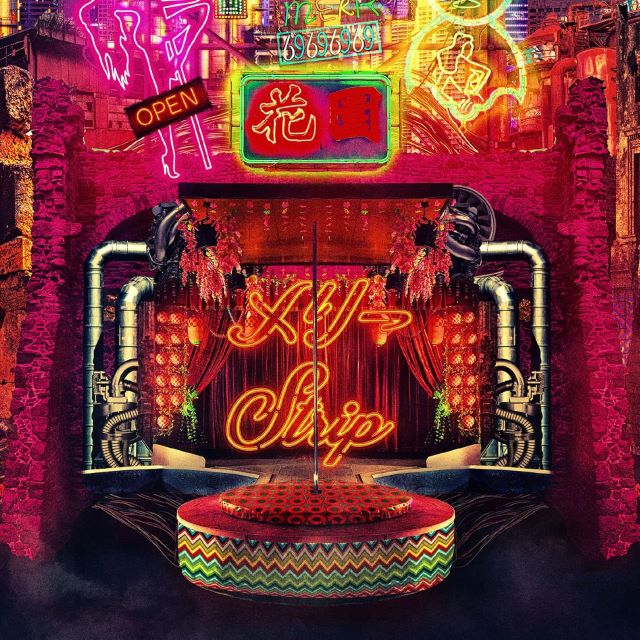
What would Merry sound like without their founding guitarist Kenichi, who quit the band about two years ago? As it turns out, not all that different. Given the fact that he wrote increasingly fewer songs on the Tokyo band’s recent albums, that should not be all that much of a surprise, but the fact that his and Yuu’s guitars played completely different parts was an important part of Merry’s sound. And yet, ‘Strip’, the band’s first album as a four-piece, sounds exactly like one would Merry expect to sound. It plays to almost all of the band’s strengths.
‘Strip’ has, however, notably been arranged around the idea that these songs can be played live without feeling like they are lacking something. Yuu approached the guitar arrangements less as lead and rhythm guitars. Despite some extra parts, there is usually one dominant guitar part that will likely be the one tackled on stage. As a result, bassist Tetsu gets a little more room to play around with slightly more melodic bass lines. This is always good news, as Tetsu is in my opinion one of the most criminally underrated bass players in J-rock. You won’t hear him play any virtuosic leads, but his parts always enhance the songs.
Merry sounds best when their sound is nostalgic and retro-focused. They have gone back to that on recent albums after attempting an increased amount of aggression for a while and thankfully, ‘Strip’ continues that stylistic direction. Describing the style is a nightmare, but imagine a somewhat punky alternative rock band having to tone down their sound a bit to fit jazz cafés and blues clubs. In fact, that’s exactly how I would describe the subdued darkness of ‘Tooi Mukashi No Ren’ai Song’. I love Tetsu’s simple, yet extremely soulful bass line on that particular song. ‘Tabako’ features drummer Nero hitting slightly harder, but it fits the description just as well.
With ‘Strip’ being only just shy of 37 minutes, I tend to listen to it in its entirity, which usually makes picking highlights difficult. Still, ‘Rat-A-Tat-Tat’ is a stand-out moment due to the teasing, vaguely Middle-Eastern sounding melody that runs through the song and the interesting changes in Nero’s rhythmic approach. The atmosphere of ‘Ai Nanten Shosen Gunso De Tsugo No Ii Mono Nanoni’ is incredible as well. Gara isn’t necessarily a great singer, but exactly knows how to wring every last bit of nocturnal eerieness out of all his notes. Opener ‘Psychedelic Division’ and closer ‘Mechanical Words’ are Merry’s trademark sound simply executed really well.
Although ‘Strip’ is not quite as good as its predecessors ‘M-Ology’ and ‘Nonsense Market’, it manages to deal with the departure of a founding member remarkably well. Really, the only downside about the album is the overly electronic ‘Blue Moon’. The pre-chorus of the song is quite good, but I would have preferred guitars to bleeps and bloops without question. Everything else is simply doing Merry what they do best, just as a quartet. “Retrock” as they call it and that is exactly the way I like to hear them. I was not too hopeful about their future when Kenichi left, but I sure as hell am now.
Recommended tracks: ‘Rat-A-Tat-Tat’, ‘Tooi Mukashi No Ren’ai Song’, ‘Ai Nanten Shosen Gunso De Tsugo No Ii Mono Nanoni’
Order ‘Strip’ from nearly anywhere in the world through CD Japan below

 Kevy Metal
Leave a comment