
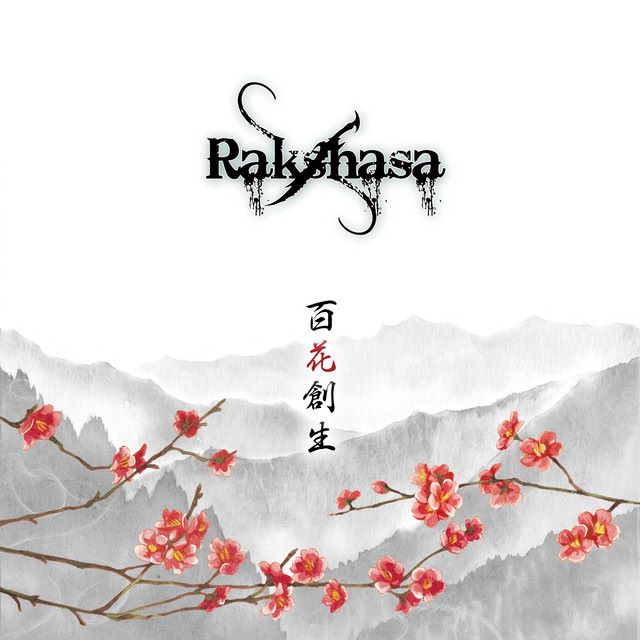
Rakshasa came to my attention while searching for bands that sound like Onmyo-za. They don’t really; both bands have an approach that combines heavy metal with traditional Japanese elements in their sound and aesthetics, as well as an emphasis on female vocals – pretty much exclusively in Rakshasa’s case – but their approaches vary significantly. Another thing Rakshasa’s second album ‘Hyakka Sousei’ doesn’t really resemble is their own debut ‘Rikudo Rasetsu’. While it is clearly the same band, the songs on ‘Hyakka Sousei’ sound more streamlined and far more melancholic. A massive improvement: the album is all the better for it.
Multiple members of Rakshasa play in more extreme bands, such as Ethereal Sin and Wirbelwind. And it shows. While ‘Hyakka Sousei’ is a highly melodic affair, many of the guitar riffs would not have sounded out of place on the more melodic end of the extreme metal spectrum or in a relatively extreme folk metal band. Rakshasa never sounds too extreme, however, as their songs make admirable use of space and Yuri has a fantastic voice that perfectly carries the abundant melancholy present on ‘Hyakka Sousei’. Many folk-ish metal bands go for the battle atmosphere, Rakshasa almost appears to mourn the losses of those battles, which certainly makes them stand out.
Difficult as it is to describe Rakshasa’s music in a way that does them justice, adjectives like intense, majestic end deeply moving are more than appropriate to capture the spirit of ‘Hyakka Sousei’. Except for maybe the slightly more upbeat and catchy closer ‘ChouChou Hanabi’, most of the songs have a distinct haunting atmosphere. That is not always immediately apparent; the eleven-plus minute ‘Ryojyun’ sounded a bit disjointed at first, but its dynamics and theatricality start to make more sense the more you listen to it. Similarly, the ballad ‘Yukimi Touge’ initially felt overlong to me, but is actually really cleverly written and arranged.
The songs that made a great first impression also simply just got better. It is astounding how understated the amazing ‘Genren’ is, as Rakshasa resisted the temptation to tack on a bombastic chorus by keeping the song spacious and beautifully sad. More propulsive is the excellent opener ‘Mihata No Motoni’, in which guitarist Kikka paves the way for a chorus with one of Yuri’s most powerful vocal performances on the record with some deliciously minor key, folky power metal riffs. ‘Harukanaru Wadatsumi’ probably has the most aggressive riffs on the album and a really cool single-note vocal line in the pre-chorus, while ‘Hyakka Ryouran’ has surprisingly playful rhythms.
While Rakshasa’s debut album was promising, I also kind of wished they would tone down the upbeat power metal elements and the sporadic J-rock-isms. That is exactly what they did on ‘Hyakka Sousei’. As a result, it might just be my favorite Japanese metal album of the year so far. It is a highly dynamic album that manages to keep suprising the listener even after mulitple listens and has an atmosphere I never really heard before. Rakshasa went through a number of line-up changes recently, but the songwriting core of Kikka, Yuri and bassist Yama has stayed intact. Hopefully that means there will be more excellent Rakshasa music in the future.
Recommended tracks: ‘Mihata No Motoni’, ‘Genren’, ‘Ryojyun’, ‘Harukanaru Wadatsumi’
Order ‘Hyakka Sousei’ from nearly anywhere in the world at CD Japan below
 Kevy Metal
Leave a comment