
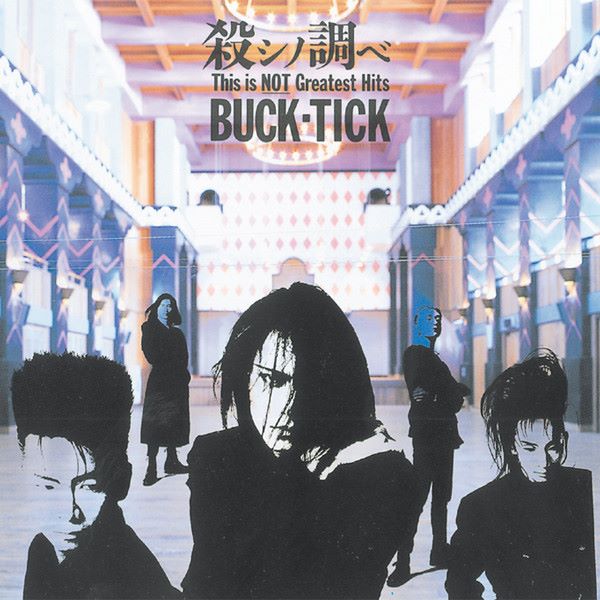
This is an article that exists solely because I wish I had something similar in order to find out if Buck-Tick’s first compilation ‘Koroshi No Shirabe: This Is Not Greatest Hits’ would be worth purchasing. While that may seem like an odd question for a compilation, this is not any ordinary compilation, as its title already subtly suggests. All of the songs have been reworked to varying degrees, which means that some of the songs have been altered significantly. If for whatever reason – mine were both biological and topographical – you are also a latecomer to the popular J-rock band, my hope is that this article will help you decide whether or not to purchase ‘Koroshi No Shirabe: This Is Not Greatest Hits’.
While I have decided not to shy away from mentioning my opinion when I feel it is warranted, my aim was to be as descriptive as possible in order to let facts rather than my opinion shape your decision. If you feel that I have not succeeded in this goal, please feel free to let me know. In case I agree, it is only little trouble to alter the article.
1. Iconoclasm
Out of all the re-arranged tracks on ‘Koroshi No Shirabe: This Is Not Greatest Hits’, ‘Iconoclasm’ is the one that most sounds like it was prepared for the strong industrial leanings of the era that followed the release. This is not only obvious from the electronic samples and noises that have been added to the beginning of the track, but also from Atsushi Sakurai’s heavily processed vocals. If anything, they sound like they have been recorded through a distorted megaphone. Personally, I think this significantly hurts the – admittedly limited – melodic qualities of the original version, but if there is one song that lends itself well for such an approach, it would be ‘Iconoclasm’. Best listened to on speakers, because it’s a little trebly and abrasive on headphones.
2. Aku No Hana
The alterations made to the justified classic ‘Aku No Hana’ are subtle enough to fool the casual listener into thinking that they were minor, but some of the changes were rather substantial. The overall sound mix is considerably brighter and more balanced than the mildly murky production of the album with the same name. While I’m not quite sure if the instruments were re-recorded or just remixed, Sakurai’s vocals went through some notable changes. Not only does his voice sound a tad deeper than on the original, some parts have been changed, like the whispers that end every other line of the verses. Overall an improvement over the original, though cutting out the vocals of the characteristic “I’m falling down” bit near the end was a bad idea.
3. Do The “I Love You”
A minute and a half longer than the original and that’s not because of an extended break or something similar. The song is substantially changed from its hyperactive, punky original incarnation into a new wave track with a more seductive groove. This version would not have sounded out of place on an INXS album. Hisashi Imai’s guitar solo remains surprisingly faithful to the original, it may actually be lifted directly from the original ‘Sexual XXXXX!’ recording. The accompanying parts are more streamlined, with especially the absence of the sudden crazy noises being notable.
4. Victims Of Love
Another track that is much longer than its previous version. Nearly twice as long in this case. For a more than significant part, this is due to its much slower tempo, which fits the dangerously seductive atmosphere Buck-Tick were going for much, much better. They would nail it completely on the ‘Climax Together’ live video recorded the same year, but this studio version is an excellent attempt as well. It is surprising to see how much Sakurai’s voice has developed in the less than four years since the original release. His somewhat deeper tone completely tosses the almost innocent quality of the original vocals out of the window, finally allowing him to make his vocals sound like they were probably intended. The abrupt ending is a bit of a downer though.
5. M.A.D
Easily the most recent song by the time the album was released – along with ‘Speed’ and ‘Jupiter’ – and therefore, it is kind of strange to see how much they changed it. The highly cinematic intro – think film music meets electro or maybe Enigma without choirs – made me hopeful about the outcome, but the rest of the track left me disappointed. Instead of a quirky, uncomplicated, Talking Heads-ish new wave track with some cool vocal harmonies, the re-arranged version of ‘M.A.D’ is high on electronic rhythms, sudden explosions of synth and aggressive vocals reverberating in the distance. As much as I would like to commend Buck-Tick for their creativity here, I don’t think the result is listenable enough.
6. Oriental Love Story
In its original version on ‘Seventh Heaven’, I have always thought ‘Oriental Love Story’ was promising, but also suffered from productional limitations. The new arrangement definitely improves upon that, though in a different way than I was expecting. When I saw the song was on this album, I expected Buck-Tick to further emphasize the “new romantic” atmosphere of the original and they certainly do in the first couple of minutes, but the song develops into something considerably more propulsive when the full band kicks in. Whether or not that is a good thing depends on how you prefer the song. Personally, I would not have minded a dreamy, romantic track, but the song works very well as an optimistic new wave rocker.
7. Speed
Right off the bat, the most notable change here are the sound effects carried over from the cross-fade of ‘Oriental Love Story’. That also means Imai’s lead-in measure has been sacrificed, but apart from that, the differences with the original version are quite minimal and superficial. The mix is certainly a lot brighter and it seems like Imai has added a lot of extra effects to his guitars, he may even have re-recorded his rhythm guitar in the middle section to make it sound a bit more funky. Also, some vocal textures have been added, though it is entirely possible that they were there already, they have just been made more audible in the mixing process this time around.
8. Love Me
If you don’t like Hawaiian style slide guitar work, avoid this version of ‘Love Me’ like the plague. That also counts if you found Sakurai’s vocals on the original version on the verge of being too schmaltzy, because this arrangement pushes the rest of the track into that territory as well. No longer do Imai and Hidehiko Hoshino deliver chorus laden chords that sound like a mix of late seventies punk and early gothic rock; instead the guitars are calm, shimmering and drenched in reverb. As you may have already understood, it’s also quite a bit slower than its original version. To be honest, I personally am not a big fan of either version, but if I had to choose, I would certainly go for the more energetic original.
9. Jupiter
‘Jupiter’ was an excellent ballad to begin with – Buck-Tick has quite a lot of those in their catalogue – so my guess is that they wanted to alter the track for this release just to include it. There is a lengthy Gregorian-style choir chant opening this version, but the rest of the track has just been embellished slightly. The vocal harmonies appear to have been redone, as their execution sounds better than on the original, Yutaka Higuchi added some cool, subtle fretless bass flourishes in the calmest sections and Imai reinterpreted his guitar solo. Some of the choir singers return on the background in the final chorus, but overall, ‘Jupiter’ feels like the original version with an intro tacked on.
10. …In Heaven…
On the surface, the reimagined version of ‘…In Heaven…’ does not sound that different from the version on ‘Seventh Heaven’, except for the grateful use Buck-Tick makes of the technological progress that has been made in the intervening years. New vocal textures have been added to the chorus and Imai explores the pleasures of harmonizing in the lead guitar parts, but overall, it is still pretty much the same song. And yet, it sounds so much more powerful than the already impressive original. The much clearer mix is definitely a part of the reason why. Yagami Toll’s drums especially sound massively improved in this version, but I also think Higuchi’s bass has more balls this time around. Whatever the reason, this is the definitive version of this delightful pop rocker, even though it still does not fix the awkward English. Oh well…
11. Moon Light
‘Moon Light’ more or less becomes the second part of a diptych with ‘…In Heaven…’ for this release. It kind of makes sense too; both songs have a similar upbeat “in love for the first time” vibe. In order to optimize the transition, I think ‘Moon Light’ has been adapted to fit alongside ‘…In Heaven…’ more than the other way around. The song has been slowed down slightly and the bright, clear guitar sound definitely sounds fitting to the ‘Seventh Heaven’ sound. This is still largely the same song as on ‘Hurry Up Mode’ though. The structure is largely the same and so are the melodies, though I think Sakurai has come a long way since the band’s debut album. Imai’s guitar solo on this version is beefed up and really cool here as well.
12. Just One More Kiss
If you want to appreciate what a good rhythm guitarist Hoshino is, by all means check out this version. This is something that stands out most when you listen to it on headphones and you can really make out all the subtleties of his picking hand. ‘Just One More Kiss’ on this release actually focuses slightly more on clean guitars as far as Hoshino is concerned than it did on ‘Taboo’. Apart from that, differences are relatively minor, though the shift from slightly distorted to clean might throw avid fans of the original off. Too bad that the only flaw in this furthermore more than decent song – the large amount of repetition in the last three minutes – is still there in the remake.
13. Taboo
‘Taboo’ is the reason why I considered buying ‘Koroshi No Shirabe: This Is Not Greatest Hits’ in the first place. The original is a masterful, goosebumps-inducing new wave track full of seductive grooves and vocals that really only could have been made in the eighties and – along ‘Tokyo’ – the highlight of the eponymous album. But what that song does not have is this incredible bass line courtesy of Higuchi. Here, ‘Taboo’ is completely reimagined. Whilst retaining the general melodies of the original, the guitars are much more sparse and the track is more oriented on almost jazzy grooves, though Yagami is too much of a hard hitter to go full jazz. The result: instead of one, Buck-Tick now has two utterly amazing tracks named ‘Taboo’ with the same lyrics and vocal melodies, but surprisingly little in common otherwise.
14. Hyper Love
Another track that is seamlessly connected to the previous one – Buck-Tick seemed to be in the mood for that when they sequenced the album. Not unlike ‘Victims Of Love’, the subsequent ‘Climax Together’ live recording is more powerful than the studio version, but I’m still on the fence about this one. Yes, Sakurai’s vocals are better than on the original and the chorus, while maybe a tad silly, is an improvement, but I’m a little conflicted about the verses. They have a powerful, almost tribal feel, but they also kind of lack the mysterious menace of the original. That sounds like the album ends disappointingly for me, but admittedly, it works really well in terms of flow here.


 Kevy Metal
Leave a comment