
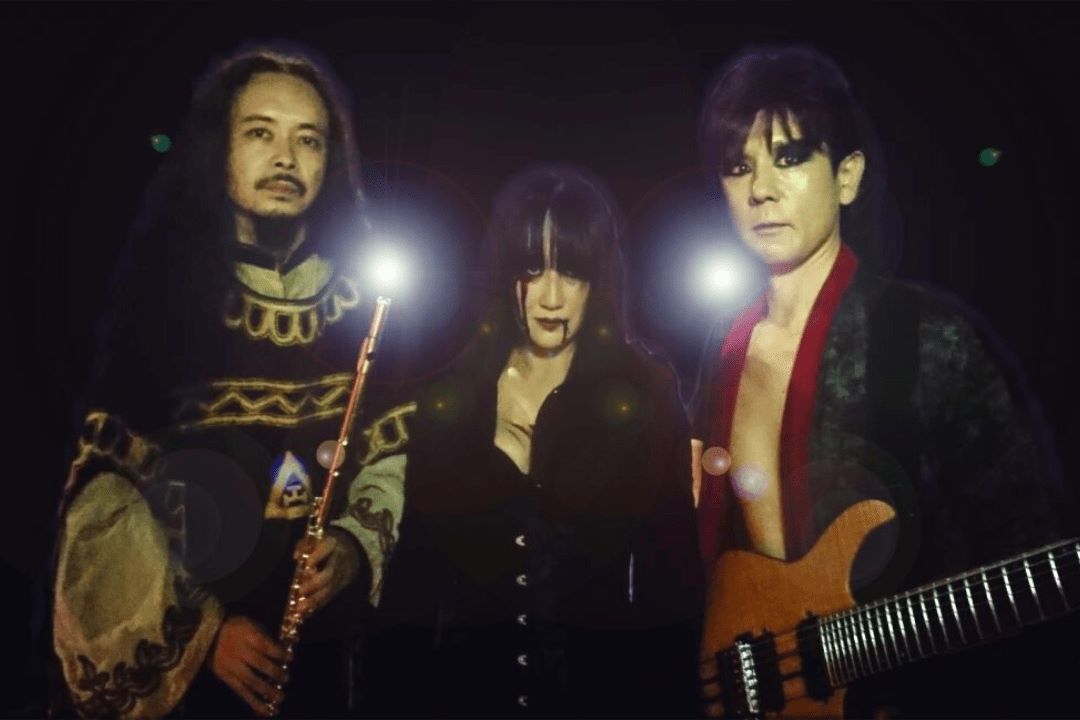
Eccentric is probably the best word to describe Sigh. Their sound is anchored in extreme metal – black metal particularly – but is rife with influences from other genres. Progressive and psychedelic rock, classical music, jazz, electronic music… All of these are elements that have been appearing in their experimental music since the mid-nineties. “Black metal encompasses almost every musical genre“, says singer, multi-instrumentalist and band leader Mirai Kawashima. “All kinds of bands from Blasphemy to Alcest and Deafheaven are often categorized as black metal. Black metal is so non-limiting that it does not describe any musical style at all. Also, obviously, what we play is not thrash or death metal, so we stick to the black metal tag.”
November 16th sees the release of Sigh’s twelfth album ‘Heir To Despair’. On it, the extreme metal has almost been put on the background in favor of distinct influences from progressive rock and East-Asian folk. “The seventies prog vibe has always been there, say since ‘Gastly Funeral Theater’ (1997)”, says Kawashima. “I love crazy prog stuff from the seventies and I am a vintage keyboard collector. Also this time, I tried some flute, which must give a more prog feel to the album. Actually, ‘Graveward’ (2015) was supposed to be a very prog album, but during the recording, I got into more orchestral stuff and the direction of the album drastically changed.
As for the Asian feel, I’ve been experimenting a lot with the traditional Japanese way of singing and wanted to incorporate that into Sigh’s music. And this time, most of the lyrics are in Japanese. I can sing much better in Japanese, as I do not have to care about the accurate pronunciation, unlike when I have to sing in English. Also, I thought the Japanese lyrics could give a different atmosphere to the songs. And to be honest, not much is left for me to say in English after ten albums…”
Expectation
When Kawashima announced the release of ‘Heir To Despair’ on social media, he said that everyone would hate the album. Allegedly, no one who heard it liked it. Have the reactions been a little better in the meantime? “So far only ‘Homo Homini Lupus’ has been published“, Kawashima explains. “And actually, it’s got a lot of positive reactions. However, the song does not represent the album in any way. The feature of ‘Heir To Despair’ is an Asian taste and the use of flute. ‘Homo Homini Lupus’ does not sound Asian and does not feature the flute. People liking ‘Homo Homini Lupus’ means there’s a bigger possibility that they are going to hate the album.”
Not that Kawashima cares: “Especially right after the album release, the audience reaction is rather misleading. When ‘Imaginary Sonicscape’ (2001) came out, more than half of the reviews were more than bad. People were thinking that we were a black metal band and the album did not sound black at all, so they were confused. But seventeen years have passed since then and ‘Imaginare Sonicscape’ must be one of the most popular Sigh albums. When people listen to an album for the first time, they just listen to the gap between their expectation and the actual music.”
Objective
‘Heir To Despair’ has a remarkably clean, almost polished sound. The contrast with the raw production of ‘Graveward’ could hardly be greater. This is not the first time that there is such a sizeable difference between the sonic approach of two consecutive Sigh albums. “I believe it pretty much depends on the direction or the theme of the album“, Kawashima explains. “The theme of ‘Scenes From Hell’ is hell, so we wanted a hellish production. The production of ‘Heir To Despair’ was kind of an experiment. ‘Graveward’ was engineered by our own guitarist, which I must say was a big failure. I’m not saying he was a bad engineer or anything, but he was too biased. Obviously he wanted his guitar to be heard more than anything and he knew too much about the songs, which excluded objectivity.
In order to maintain that objectivity, I left it up to our Canadian engineer Phil Anderson this time. Of course I wanted some of my playing or vocals to be more audible, but I didn’t say anything about it, as it was an experiment of objectivity. I guess it worked very well.”
Insanity
A thematic approach is Kawashima’s modus operandi anyway: “The concept of this album is about insanity. I’ve been wondering what insanity is these days. Of course, there are some real mad people of whom everyone can tell that they’re mad, but insanity is not always that distinctive. It’s just a matter of where to draw the line between sanity and insanity and it is one hundred percent arbitrary. When you are insane, you cannot tell that you are. I don’t think I am insane. I think that what I am saying in this interview makes perfect sense, but there is no way to assure that. Completely insane people probably think they’re talking completely logical.
The artwork by Eliran Kantor perfectly describes what I wanted to express with the music. The woman looks happy, but everything else on the artwork is wrong. The plant is dead and the room is a mess. As I said, insanity is not always very distinctive. Some people look very normal while having a deep darkness inside their mind. And that is the real horror.”
Spontaneous
Since Sigh commenced activity in the late eighties, the band has been centered around Kawahima. More often than not, these kinds of line-ups tend to be highly unstable, but Sigh always maintained a relatively constant line-up. Save for the arrival of guitarist You Oshima in 2014, the band has not had any line-up changes for over a decade. “I’m sure there should be better players“, says Kawashima. “But what makes them peculiar is that they are all crazy in some way, which works good for Sigh maybe. They are all really hard people to work or communicate with. It’s truly frustrating that I have to deal with them, but maybe that is proof that they are artistically unique. At least I hope so.”
Yet, it is Kawashima who is pulling the strings. “I write most of the songs and all the lyrics“, he explains. “As for ‘Heir To Despair’, half of ‘In Memories Delusional’ was written by our guitarist You Oshima and I left all the guitar solos up to him, but I can say that’s the only compositional input from the other band members.
My method of composing varies. Sometimes I compose playing piano. Sometimes I just come up with the ideas walking down the street. I usually keep collecting those bits and pieces and assemble them into a song on MIDI. Then I keep listening to the demoes and change or rearrange them until I am a hundred percent satisfied with it. Then I pass it on to the other members. The songs on ‘Heir To Despair’ were composed very spontaneously compared to the past ones. I usually use a lot of musical theories to arrange the songs, but this time I did not think about theories that much. I just kept writing without thinking that much.”
Success
Compared to many other Japanese bands, Sigh has a reasonable degree of succes worldwide. “It’s just a matter of how you define success“, Kawashima nuances. “I personally do not think Sigh succeeded at anything. Anyway, I just thank Euronymous (guitarist of the Norwegian black metal band Mayhem, who was murdered in 1993). When we were hunting for a label around 1992, he was the only one who showed interest in us. I am not even exaggerating anything. I sent the demo to every label in the world and nobody but Euronymous wanted to sign us. So without him, Sigh probably would have ended up a demo band. He liked us, then the black metal boom happened. Nobody or nothing else got us that.”
Since being signed to Euronymous’ Deathlike Silence Productions, Sigh has been performing all over the world, albeit not that frequently. Not even in Japan. Yet, Kawashima notices a difference in preferences: “Here in Japan, our most popular album is obviously ‘Hangman’s Hymn’ (2007), so when we play here, we play more songs off this album. In Europe and the US, I believe they want to hear earlier, more black metal stuff, so when we play abroad, we play a lot from ‘Scorn Defeat’ (1993). In the coming weeks, we will play some shows with Dimmu Borgir, Gorgoroth, Samael and Sinsaenum and we will play only songs from after 2007 and almost all the songs are fast. That’s what the Japanese audience wants.“
 Kevy Metal
Leave a comment